
- Blog Home
- Recent Posts
- Sending Love and Supplies to Children in Need
- Generation to Generation Society: Making Waves in ...
- The Joyce Eisenberg-Keefer Medical Center Welcomes...
- The Meaning of the High Holy Days
- Save the Date! Celebration of Life: Reflections 2015
- Rabbi Karen Bender Joins the Journey for Justice
- Hebrew Union College Students Visit the Home
- Residents Enjoy Films at the Laemmle Theater
- The Joyce Eisenberg Keefer Medical Center Centenar...
- Save the Date for the Walk of Ages XVI
- Post Categories
- Posts by Author
- Blog Archives


Los Angeles Jewish Home's Blog
Friday, November 30, 2012
What makes a community? — Letter from the Rabbi
And then there are those times when residents express wholehearted appreciation for staff, like when someone at a residents’ council meeting says that, say, Housekeeping or Maintenance or Activities are “wonderful” – and lots of other people agree. Around Thanksgiving, I asked in various groups what residents were thankful for. Top of the list for so many people was the Jewish Home!
It’s interesting to think what this means. We could look at the Home as distinct groups of people, each with their own separate role: those who live here (or receive the Home’s services in other ways); and those who are employed here; those who volunteer their time and energy and skills, and those who donate financially. Yes that’s one way of looking at the Home, but in fact it is much richer than that.
I have been asking myself the question: what makes a community? I believe it is much more than, say, a group of people who live in the same place; or a group of people who work in the same place. A community (just like a family) is held together by invisible bonds – they may be bonds of love and caring; or, just as important, bonds of obligation.
Then we may look at the common purpose that brings a group of people together. The purpose of the Home is to bring the highest standards of care to seniors, in keeping with Jewish values. All efforts are aimed at giving the best to residents and to others who receive the Home’s services. In this way, the Jewish Home is an organization with a purpose. It meets that purpose to a pretty high standard – which is a prime reason residents are so thankful for it.
But the Home is not just an organization; it is also a community. Certainly it is there for the residents, but it also plays an important role in the lives of staff and volunteers and donors (and let’s include those who give their time to serve on the Home’s governing bodies).
All have the potential to give to others, and all have the potential to have their lives enriched by the web of relationships, the obligations and the caring, the warmth and the friendship, the sense of belonging that membership of a community like this can bring.
Some of the employees have been with the Home for 20 or 30 or more years. Some stay in the same jobs over the years, while others take advantage of the opportunity the Home offers to move up to more satisfying or senior roles. Those who work here enjoy their relationships with each other and with the residents; and many experience a fulfillment that comes from being able to contribute to the life and wellbeing of others. And I know how much most of our residents enjoy their connections with the staff and appreciate what they do.
I have just had the privilege of participating in events that gave me a new sense of this Jewish Home family. On the days before Thanksgiving, Rabbi Rita and I co-hosted interfaith services on both campuses for employees of the Home, alongside a Catholic Priest and a Protestant Pastor. I found this coming together of staff members and clergy from different backgrounds very moving.
Here at the Home, people fill different roles – residents, nurses, dietary or maintenance staff, administrators, and many more – and come from many backgrounds and traditions. What I have come to see more clearly than ever before, is that there is so much more that unites us than divides us. Together, we are a community, and I am thankful to be part of it.
 Rabbi Anthony Elman is the Skirball Director of Spiritual Life at the Jewish Home and also serves as Rabbi of the Home's Grancell Village campus. His professional background is multifaceted, encompassing the fields of law, social work, and psychotherapy. Rabbi Elman has been with the Home since his ordination and graduation from the Academy for Jewish Religion-California in May 2007
Labels: Community, Elman, Jewish Home, Letter from the Rabbi
Thursday, May 26, 2011
Reaching Out
Coincidentally, the Jewish Home is reaching out and offering our expertise in senior care to the broader community. Perhaps you read our eNews update introducing our four-event Community Education Series.
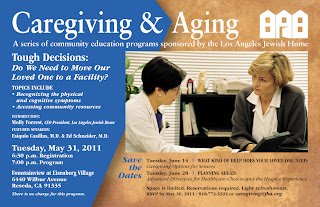 Just like Heritage Pointe in New Jersey, we recognized that many in Los Angeles want information regarding the best options available for aging loved ones. To better serve that need, the Jewish Home is hosting seminars on the various aspects and options surrounding aging and eldercare.
They are all free of charge.
The second event in our series is coming up the Tuesday after Memorial Day. It will cover common physical and cognitive issues associated with aging, how to recognize when help is needed, and the community resources available to you. The event features two experts in geriatric medicine, Dr. Edward Schneider and Dr. Esiquio Casillas. If you or a loved one are interested in issues regarding aging and care options, this is an hour you won't want to miss.
For more information on the Jewish Home's Community Education Series, click here or on the picture of the event postcard.
Labels: Aging, Assisted Living, Baby Boomers, Blog, Community, Cross Post, Education, Long Term Living, Sandwich Generation, Seniors, Series, Staff
Monday, May 9, 2011
What Are You Doing May 17th?

Often, seniors must look to the care of others so they can continue to add life to their years. Whether dealing with the normal signs of aging or abrupt emergencies, it pays to be prepared. With a little education and some planning ahead, the transition into the different levels of care can be seamless and nearly stress free.
Starting this month, the Los Angeles Jewish Home's expert staff is organizing four short seminars to help with that education and planning process. From choosing the best in-home caregiver, to in-residence options, advanced directives, and hospice care, we want to help the greater Los Angeles community care better for their aging loved ones.
Our first seminar will be held on Tuesday, May 17th at 6:30pm. Entitled How to Find, Hire, and Manage the Right Caregiver, the Jewish Home's vice president of human resources, Shelly Ryan, and the CEO/administrator of our skilled nursing hospital, Ilana Grossman, will explain what to look for if you or someone you love needs a little extra daily assistance.
Oh, one more thing — all four events are free! But space is limited and reservations are required.
For more information, click on the picture to see the official event postcard. Or, you can visit here to see the web version.
Labels: Aging, Caregiver, Caregiving, Community, Education, Free Seminar, Healthy Aging, Jewish Home Event, Planning, Senior Care, Staff
Monday, April 25, 2011
USC Grad Student Covers 99th Annual Passover Seder

In 2011, Passover continues to have special meaning for the Home. Last week, for the 99th year in a row, we celebrated Passover. On the second night, we opened our home to residents, families, and anyone around the community for our traditional Los Angeles Community Seder. Word of this special Seder spread far enough so that USC graduate student Benjamin Gottlieb decided to cover the event in the USC Annenberg School of Communications blog, Neon Tommy.
Check out the video report he made!
Also, take a look the photo album by Andy Holzman of our Community Seder on the Daily News website!
We'd like to extend a huge thank you to Benjamin for stopping by and producing some great footage, to the Annenberg School for Communication & Journalism for including our tradition on their school's blog, and to Rabbi Rita Hertzberg for leading an amazing Seder.
Labels: Andy Holzman, Annenberg, Benjamin Gottlieb, Blog, Community, Cross Post, Daily News, Hertzberg, Media, Neon Tommy, Passover, Pesach, Photos, Report, Seder, Seniors, USC, Video, Vimeo
Monday, April 18, 2011
Letter from the Rabbi – In Praise of Freedom, Part II
When I was discussing Passover in one class recently, I asked what freedom was about. The first answer I got was "the right to express yourself." Indeed, free expression is one of the central principles of a free society, like in the United States.
But freedom of expression is very important on a personal level too. Even when we are surrounded by other people, we can still feel we are on a desert island. If I feel myself totally alone – an individual without real relationships, not truly part of a community – am I free to express myself? Not really, I think. I can truly express who I am only to people I can trust, people who care for me and will listen to me.
Let us remember, this Passover, that our true freedom lies in relationship and in community. Let our own Exodus be from loneliness to relationship, as we reach out to each other, and get to know cherish each other. Through those caring relationships we will all find our dignity and our freedom.
I wish you all a happy – and heart-warming – Passover!
Rabbi Anthony Elman serves as Rabbi of the Jewish Home's Grancell Village Campus. His professional background is multifaceted, encompassing the fields of law, social work, and psychotherapy. Rabbi Elman has been with the Home since his ordination and graduation from the Academy for Jewish Religion-California in May 2007
Labels: Community, Dignity, Elman, Exodus, For the Spirit, Free Society, Freedom, Freedom of Expression, Friends, Friendship, Island, Loneliness, Passover, Pesach, Relationships, Seniors
Letter from the Rabbi – In Praise of Freedom, Part I
Passover is known as the season of our freedom. But why is freedom so important? Why are people across the Middle East and North Africa even at this moment struggling, and sometimes dying, for freedom? Watching the news of those struggles has led me to think more about what it means to be a free person, and part of a free people.
People held down by a dictatorship or foreign power cannot fully thrive. It is not just that they cannot choose what to do; something in the soul of a people is beaten down. Their imagination and inventiveness are squashed — they are a people without true dignity.
Is freedom simply about being able to do as one wants? (Can any of us really do everything we want?) In our Jewish story, leaving Egypt meant we did not have taskmasters telling us how to live every minute of our day. We were free from those restrictions, but that didn't mean we were free to live a worthwhile and dignified life.
That is why Passover — the season of our freedom — and Shavuot — the season of the giving of our Torah — are so closely connected. Torah gives us laws and ethical principles, so that we know that real freedom lies in how we interact in our community and our larger society. First and foremost, the Jewish people are obliged by Torah to love our neighbor as ourselves; we must not oppress the widow and the orphan; we are repeatedly told to be respectful of the stranger who lives in our society, remember what it was like when we were strangers in Egypt.
Torah reminds me that in a free society, I have a duty of care and consideration for my fellow men and women. The free society that Torah gives us is one in which we are bound together in relationship.
Ideally we do not celebrate Passover in solitude. We celebrate it in groups, in families, in communities. At the Seder, we read from the Haggada "let all who are needy come and celebrate Passover." It is together that we are able to taste the sweetness of this "season of freedom".
Rabbi Anthony Elman serves as Rabbi of the Jewish Home's Grancell Village Campus. His professional background is multifaceted, encompassing the fields of law, social work, and psychotherapy. Rabbi Elman has been with the Home since his ordination and graduation from the Academy for Jewish Religion-California in May 2007
Labels: Civil Rights, Community, Dignity, Egypt, Elman, For the Spirit, Freedom, holiday, Israelites, Judaism, Letter from the Rabbi, Moses, Passover, Pesach, Torah
Wednesday, May 5, 2010
A Giving Time of Life
The horrific earthquakes in Haiti and Chile and the suffering they inflicted have led to a remarkable outpouring of assistance from around the world. The scale of this humanitarian response has led many of us to reflect on the nature of giving.
Material help, like money or food for disaster victims or for the homeless in our own community, is just one of the ways we can, and do, give of ourselves. Some — in war and peace — give their life for others, for their country, or for an ideal.
But giving can also become a way of life. Each of us can choose to share our love or energy, time or advice at every opportunity. We can take a moment to listen or share a thought or a smile that makes someone feel understood, recognized, not alone.
A Culture of Giving
Jewish tradition has quite a lot to say about our personal responsibility to give. The Torah teaches us to protect the "widow and the orphan," which extends to all of the vulnerable in our society. And Judaism puts great emphasis on the concept of "tzedakah." This is a complicated word that draws much of its beauty and authority from its dual focus on doing what is right here and now, and acting in the pursuit of justice.
Thus, by acknowledging his or her cultural identity, a Jew is required to give, especially to relieve poverty and suffering. Tzedakah is not 'merely' an ideal. It is not something we choose to do when we happen to be feeling generous, but an obligation of our tradition and culture.
Giving of this type was exemplified by those many American Jews who worked and risked their lives in support of the Civil Rights Movement of the 1960s. One woman involved in that struggle recalled that her actions were motivated by the principle from the Torah not to stand idly by when others are facing a difficult plight.
Giving as the Basis of the Community
In order to create a true community, must we each contribute in some way? Almost everyone I ask responds 'yes' to this question. But more than just enjoying the benefits of belonging to a community, people seem naturally motivated and energized to contribute, and are often creative about finding opportunities to do so.
For seniors who no are no longer independent, these opportunities are not as obvious as they once were. But by contributing our love and energy, time or advice, we can create the sense of community almost anywhere. A simple gesture of warmth, friendship, or conversation with others at a nursing station or attending an activity or a class — and actively participating at those events — is an act of giving that helps bring the community alive.
Meaning from Each and Every Day
I hear from many seniors who are experiencing a lack of meaning in their lives. Some feel that their time of giving in life — whether this was discovered through raising their family or having a successful career — is over, and with it went much of the meaning of their lives.
To those who wish to find meaning by giving to others, I suggest that the simple acts of kindness and generosity, or participation in community wherever and whenever the opportunity arises, are real and valuable moments of giving.
Indeed, every opportunity we take to contribute to the life and well-being of the community is a win-win. Others gain from what we give, and we ourselves gain immeasurably from the act of giving.
Rabbi Anthony Elman serves as Rabbi of the Jewish Home's Grancell Village Campus. His professional background is multifaceted, encompassing the fields of law, social work, and psychotherapy. Rabbi Elman has been with the Home since his ordination and graduation from the Academy for Jewish Religion-California in May 2007
Labels: Community, Elman, Feature Articles, For the Spirit, Giving, Judaism, Philanthropy, Tzedakah