
- Blog Home
- Recent Posts
- Sending Love and Supplies to Children in Need
- Generation to Generation Society: Making Waves in ...
- The Joyce Eisenberg-Keefer Medical Center Welcomes...
- The Meaning of the High Holy Days
- Save the Date! Celebration of Life: Reflections 2015
- Rabbi Karen Bender Joins the Journey for Justice
- Hebrew Union College Students Visit the Home
- Residents Enjoy Films at the Laemmle Theater
- The Joyce Eisenberg Keefer Medical Center Centenar...
- Save the Date for the Walk of Ages XVI
- Post Categories
- Posts by Author
- Blog Archives


Los Angeles Jewish Home's Blog
Monday, June 24, 2013
Hedgehogs and Rabbits and Snakes…Oh My!

The Outreach Program was created to reach out to individuals who cannot easily visit the zoo. Trained docents, such as Norma Porter, Rose Marie Walker, and Marjorie Hawkins, bring small, live animals and other touchable items to nursing homes, schools for children with disabilities, hospitals, and daycare centers. Norma, who has been a docent with the zoo for sixteen years, explains, “It’s very hands-on. We encourage our audience to touch the items (including pelts and skulls from animals that died of natural causes) and to touch the animals as well. For seniors, it’s also a chance to reminisce, perhaps about an animal from their childhood.”
 Francine Finkelstein, director of therapeutic activities at JEKMC, says, “This was a great opportunity for our residents to see the animals, touch them, and relate to them.” And relate to them they did! From the first presentation – actually a stuffed life-sized toy kangaroo complete with a “joey” in her pouch – the residents were engaged. Did you know that, when a kangaroo is born, it’s about the size of a walnut? This was the first of many interesting facts the docents shared.
 During the first part of the program, residents had the opportunity to see and touch pelts from a coyote and an ocelot, as well as two pelts from reindeer (one lighter to blend in with snow and thicker to provide protection from the cold of winter). The residents learned how diet is related to jaw and tooth structure for various animals.
 Then the fun really began as the live animals came out to meet the residents. First up: a black and white guinea pig, a popular pet in many homes. Handled by a docent, Gabby, as she is nicknamed for the noises she makes, was touched gently with two fingers by willing residents. Just stroking her fur brought smiles and laughter to the room. The rabbit was next, with everyone oohing and aahing over her incredibly soft fur. The hedgehog required thick gloves to be worn by the docent and provided a look at her adorable little face, but no touching! Lastly, the tortoise and the snake took their turn around the room, with some opting not to learn what the snake’s skin feels like.
 The docents brought energy and obvious passion for their volunteer work to the event, and the residents responded to them and their charges with openness and wonder. “It was very interesting and so informative,” said resident Muriel Peregoff. For Paul Stark, his favorite part of the program was the rabbit. “I had rabbits, and my daughter has them now,” said Paul. “My rabbit would sometimes get out of his cage, but when I called him, he would come.”
The Zoo Outreach Program provided the Home’s residents with a visual and tactile experience, an opportunity to learn new information and ask questions, and a chance to connect with a few of the animals that share this world with us.

Labels: Animals, Education, For the Spirit, Grancell Village, Guinea Pig, Hedgehogs, Jewish Home Residents, LA Zoo, Learning, Rabbits, Seniors, Special Event, Zoo
Monday, March 18, 2013
The Beauty of Art Never Grows Old
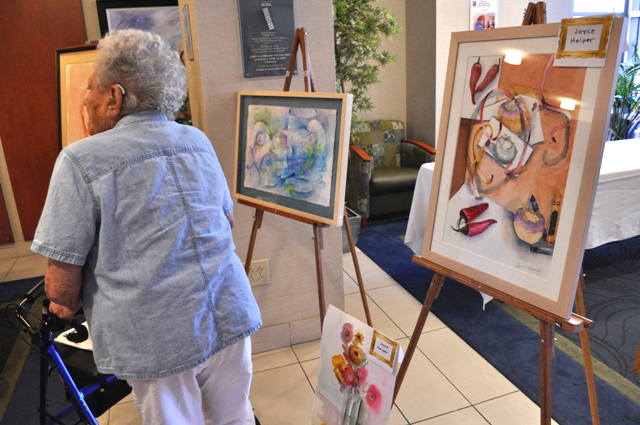
Two artists represented at the show - Joyce Halper and Ann Horn - realized their talents when they were younger and are currently in the Friday afternoon watercolors class. When she was 49, Joyce joined her cousin at an art class, and the rest is history. She signed up for lessons at Brentwood Art Center and is still painting to this day. Currently working with watercolors, Joyce says, “I love it! Painting relaxes me.”
In addition to watercolors, Ann also counts painting on porcelain in her artistic repertoire. “It’s very delicate and special,” she recalls. “It had to be fired twice in the kiln.” Two of Ann’s pieces were on display at the show, with many more with family in New York.
The residents of the Jewish Home – where the average age is 90 – have rich histories. The art show was a delightful way to be reminded of their wealth of talent. To view photos, please click here.
Labels: Ann Horn, Art Show, Arts and Crafts, Betty Blum, jewelry, Joyce Eisenberg-Keefer Medical Center, Joyce Halper, painting, Seniors
Friday, March 15, 2013
On the Road Again: Safe Driving for Seniors

As we age, however, our driving abilities may change. To minimize safety risks to ourselves and others, it’s wise to understand how aging affects our driving and learn strategies that can help us continue driving well into our senior years.
Physical Factors
According to the Automobile Association of America (AAA), seniors are safe drivers compared to other age groups because they wear seatbelts, observe speed limits, and tend to avoid drinking and driving.
On the other hand, seniors face physical challenges that can impair driving. “Older drivers may have eyesight or hearing issues that affect their driving,” says John Beringer, Sr., California State Coordinator for the AARP Driver Safety Program. “Also, reflexes and responses are slower – it takes longer to transmit information from the eyes to the brain and from the brain to the muscles.”
Mobility may also be affected. For example, neck pain or stiffness can impair being able to look over your shoulder. Leg pain might make it difficult to move your foot from the gas pedal to the brake pedal.
Medication can also impact driving performance. More than 75% of people over age 65 take at least one medication.
Taking the following steps can help minimize potential physical problems associated with driving:
- Get your vision and hearing checked annually
- Have regular check-ups and talk to your doctor about how your physical condition and medications might affect your driving ability
- Choose a car with automatic transmission, power steering and power brakes
- Do exercises to improve your flexibility
AAA and AARP both offer driving classes for older adults. “A lot of what we cover involves reviewing and reminding drivers what they knew 30 years ago,” says Beringer. “Also, many older folks learned to drive from their parents, not from a driving instructor. So they may have learned some bad habits.”
Here are some safe driving strategies, many of which apply regardless of age:
- Leave enough space between your car and the car in front of you.
- Scan far down the road continuously so you can anticipate future problems.
- Minimize distractions inside your car, such as music volume.
- Plan your route before you get in the car.
- Minimize left turns. Drivers age 65 and older are disproportionately involved in crashes involving left-hand turns. Use designated left-hand turn lanes, or make three right turns to avoid making the left.
- Try to avoid busy highways and congested traffic.
- Consider getting a car with reverse monitoring and back-up cameras, blind-spot warning systems and other crash-avoidance technologies.
There may come a time when it’s no longer safe to remain behind the wheel.
“Indications that it’s time to stop driving include getting lost on roads you should know, being told repeatedly by passengers that you missed a stop sign or finding scrapes on your car that you weren’t aware of getting,” says AARP’s Beringer.
He stresses that the age to stop driving can vary greatly. “I had an 89 year-old woman in my class with all of her faculties, and a 57-year-old that I wouldn’t want to be on the road with,” says Beringer. “We don’t age at the same rate.”
If you are concerned about someone else’s driving ability -- for example a parent’s -- join your parent as a passenger for several trips and at different times in order to get a good sense of his or her driving performance.
Encourage your parent to check his or her skills by taking a self-rating program (such as this one from the Automobile Association’s Foundation for Traffic Safety) or getting assessed by a professional such as a doctor, rehab clinic or geriatric care service.
Get a sense of your parent’s transportation needs and come up with options such as:
- Using local public and private transportation options. Try out these services with your parent in order to determine which are convenient and easy to use.
- Offering to do the driving yourself.
- Hiring a trusted friend or neighbor who needs a little extra cash.
And be empathetic: You wouldn’t want to lose your ability to drive, and neither does your parent. Keep the focus on your parent remaining safe while still getting where he or she needs to go.
 Nancy Sokoler Steiner is a freelance writer and author based in Los Angeles. Her work has appeared in Los Angeles Times Magazine, The Jewish Journal of Greater Los Angeles and Lifestyles Magazine, among other publications.
Labels: AAA, Aging, Automobiles, Driving, For the Body, Nancy Sokoler Steiner, Seniors
Now You’re Talking: How to Communicate with Seniors

“Part of the problem stems from the loss of the communal society of our grandparents and great-grandparents, where old adults were part of the matrix of life ... All this has left us unfamiliar and unschooled in how older adults think and communicate,” says David Solie, MS, in an article entitled, “The 7 Common Mistakes Professionals Make Communicating with Seniors.”
However, there are ways to improve our communication with elders. They include recognizing physical needs, modifying our communication style and gaining an understanding of psychological issues.
Physical Factors
Devorah Small-Teyer, M.S.W., Director of Social Services for the Los Angeles Jewish Home’s Joyce Eisenberg-Keifer Medical Center, notes that simply accommodating hearing or sight issues can enhance conversation.
“Sometimes a hearing aide battery needs to replaced or amplified ear phones need to be provided,” she says. “It’s important to approach someone with hearing or vision problems from the front, speak to them face-to-face, and use hand gestures when appropriate. Make eye contact, put on a smile and address them respectfully by name to get their attention.”
Small-Teyer offers several more helpful strategies:
- Be patient. Don’t rush or force the conversation.
- Try not to finish others’ sentences. Give people time to form their responses
- Speak slowly, clearly and at a reasonable volume. Don’t mumble, but don’t shout, either.
- Try to minimize distractions, such as a television playing in the room, while conversing.
Common Courtesies
In the age of multi-tasking, many of us may be tempted to check our phones for text messages or emails during a conversation. But this can feel disrespectful to the person we’re talking to. Seniors who don’t use this technology are especially likely to infer that we aren’t really interested in what they have to say.
Good communicators go beyond just understanding the information being conveyed. They also understand how the speaker feels about what he or she is saying. Try to repeat what the speaker has said, using your own words. And when it’s your turn to speak, communicate in a way the listener can understand.
Avoid “elderspeak,” the patronizing way of talking to seniors that sounds like baby talk. While it may seem like a way to show affection and encouragement, it feels condescending and infantilizing to the recipient. In fact, research shows that elderspeak can actually interfere with communication and foster contention rather than cooperation.
What’s Really Going On
David Solie, who wrote the article on seven communication mistakes, is also the author of How to Say It to Seniors, Closing the Communication Gap with Our Elders. He posits that seniors have unique developmental agendas. Just as toddlers and teens must work to develop identity and independence, Solie argues, seniors also have developmental needs. The mission of older adults, he says, is to maintain control over their lives in the face of loss and to discover their legacy – what will live on after them.
Solie believes this explains some of the communication styles we tend to negatively associate with the elderly, such as wandering from subject to subject, repeating stories, postponing decisions, or going on tangents.
“Such verbal behavior can be frustrating to us, because we haven’t learned to appreciate the tasks on their agendas,” he writes. “After all, we’re at the top of our game. We need to … cross off as many items as possible every single day. That process makes the middle aged feel powerful and in control… But elderly people have different motivators.”
We always run the risk of miscommunicating. But using patience, courtesy and clarity – regardless of the age of our audience -- will greatly increase the chance for success.
Nancy Sokoler Steiner is a freelance writer and author based in Los Angeles. Her work has appeared in Los Angeles Times Magazine, The Jewish Journal of Greater Los Angeles and Lifestyles Magazine, among other publications.Labels: Communication, For the Mind, Nancy Sokoler Steiner, Seniors
Friday, September 21, 2012
Fall Prevention

National Fall Prevention Day happens tomorrow, September 22nd—appropriately during the Fall. Organizations from coast to coast are reaching out with helpful information for seniors and their families to help stave off slips and tumbles.
Many of the most common causes of falls are well known, and the Jewish Home has been sharing the recommended ways to stay upright for a number of years. (The hyperlinked story is from December 2010.) From fall-proofing a senior's home to simply wearing sturdier shoes, the ways to prevent these catastrophic spills are relatively easy to do. Also important is physical fitness. Taking the time to keep leg, core, and balance muscles stimulated and healthy will go a long way to keeping seniors on their feet.
Recently, McKnight's, a leading long-term care and senior living magazine, published an interesting article about a new study on fall prevention. Researchers from UCLA found that among "Medicare beneficiaries [i.e., seniors] who had their cataracts removed, 16% fewer had hip fractures within the first year of surgery than those who did not."
And that percentage climbs the older the sample group gets. "Study participants between the ages of 80 and 84 experienced the biggest benefit of the surgery, with a 28% reduced risk of fractures."
So take a moment tomorrow to assess your surroundings and the living situations of the seniors you care about. A couple of simple changes could save lives.
Labels: Aging, Balance, Cataracts, Fall Prevention, Falling, Healthy Aging, Home Safety, McKnight's, National Fall Prevention Day, Safety, Seniors, September 22, UCLA
Tuesday, August 7, 2012
Miriam Rothstein: A Profile in Courage
Originally published in the Chai Journal Summer 2012 issue.

At the end of May, they were squeezed into cattle cars headed to Auschwitz-Birkenau. Her red dress was tossed into a huge pile and her hair was shaved. Everyone slept on the floor and people were brought to the crematorium. With the Russian army approaching in 1945, two kind SS guards gathered up food and escaped with the girls and eventually left after rescuing them. In the bitter cold, they finally came to a farm where they slept in the barn until Russian soldiers liberated them. Eventually, Miriam and Rachel returned to Uzhorod where they learned their parents, sister Margaret, and youngest brother Yehuda had been poisoned.
While living in Czechoslovakia, Miriam met Herman Rothstein, a guard for the Czech president. In 1946, they married and he, too, owned a supermarket. Their daughter Vera was born in 1947. In 1949, they immigrated to Israel where their son, David, was born in 1953. A year later, Miriam had tuberculosis, prompting a move to Chicago where Herman had relatives. Their youngest daughter, Mindy, was born there in 1957. Vera and Mindy currently live in LA, and David, a university professor, now lives in Israel. Miriam and Herman retired and moved to Los Angeles in 1992.
Herman died in 2000, and Miriam lived on her own, assisted 4 hours a day by helpers who cleaned and took her shopping and on excursions. Her children eventually convinced her it would be wiser to move into a retirement community. In 2008, after checking out three other communities, Miriam chose the Jewish Home. She wanted to live in a warm, friendly Jewish setting with a built in social life and clinic. We are so pleased to have her as a part of our community. Miriam enjoys playing bingo, our entertainment and many special events, Rabbi Rita’s services and classes, and the Talking Yiddish Group with Murray. Miriam wishes she knew the names of the kind SS officers. Her three children, seven grandchildren, and nine great-grandchildren give her great pride.
When I asked Miriam how she survived such harrowing experiences, she said it was hard work (which included building trenches and laying cable), eating little (mostly bread with a little jam and margarine snuck to her by a kind cook), and living one day at a time. But mostly, it was her belief that she would survive that kept her going. Miriam’s story is truly a profile in courage.
Miriam’s story was also featured in an article by Jane Ulman in The Jewish Journal. Photo credit: David Miller
Labels: Biography, Chai Journal, Courage, History, Holocaust survivors, Jewish Home Residents, Miriam Rothstein, Remarkable Residents, Seniors, Simon
Wednesday, June 13, 2012
Tapping the Power of Music — Part I

Sometimes, the things we like aren’t so good for us. Fortunately, that isn’t the case with music. It doesn’t have any calories, can often be obtained for free, and doesn’t require any special skills or abilities to be enjoyed.
In fact, music has shown a host of benefits, both physical and emotional. That’s one of the reasons it plays such a large role at the Los Angeles Jewish Home.
In terms of physiological changes, a Cochrane Review study (a study which looks at many studies) found that music reduces pain, sometimes enough to decrease required dosages of pain medication. Studies with cancer patients have shown that music therapy decreases heart rate, respiratory rate and blood pressure. And researchers in Europe have found that exposure to music can both raise the levels of antibodies and lower the amount of stress hormone levels.
Studies on the emotional impact of music show similar benefits. One study done with college students, for example, found that listening to music conferred more positive emotions. Not only that, but the music intensified already positive emotions.
“We humans know instinctively that music has primal power,” says Elena Mannes in her book The Power of Music: Pioneering Discoveries in the New Science of Song (Walker & Company, 2011). “Historians and anthropologists have yet to discover a culture without music.”
Los Angeles Jewish Home Resident Tess Friedman, 87, describes music this way: “It elates me.”
Friedman joined the Home’s choir when she came here four years ago. “It’s a way to not let yourself be old and to forget about aging,” she says about singing. “You can change your whole attitude and behavior for the day.”
Caryl Geiger, Activities Director for Residential Care, sees this effect among many residents. Professionally trained in piano and voice, Geiger directs the Home’s choir. “Everybody leaves [practice] happier than when they came in,” she says.
Lee Zuckerman, 89, was delighted to rediscover the joy of song when he joined the choir six months ago. He’s always enjoyed music – his son even became a composer – but hadn’t sung since he was in his high school choir. “I love music. I feel joy when I sing.”
But you don’t have to sing in order to experience music at the Home. In addition to enjoying the choir’s performances, residents can take advantage of a variety of musical offerings. Concerts are offered almost every Sunday afternoon, and there are also programs on Jewish music and regular sing-alongs. In addition, violist and music historian Joel Lish presents weekly music appreciation classes.
“All levels of residents respond to the music,” says Lish, founder and director of the Palisades Symphony. “Some sing along, clap to the rhythm or even play along on an imaginary instrument.”
Music will always be an integral component at the Jewish Home. As author and researcher Elena Mannes says, “Anyone who has been transported by Bach or Mozart, moved to weep by a national anthem or hymn, stirred to dance by a rock rhythm, or transported in time by the notes of a pop tune from the past knows the power of music.”
Nancy Sokoler Steiner is a freelance writer and author based in Los Angeles. Her work has appeared in Los Angeles Times Magazine, The Jewish Journal of Greater Los Angeles and Lifestyles Magazine, among other publications.Labels: Aging, Feature Articles, For the Spirit, Healthy Aging, Music, Nancy Sokoler Steiner, Seniors
Tuesday, February 14, 2012
Sweethearts Day
Jewish Home Resident
To all the ladies at the JHA
The time has come for you to say
Come on guys, get off your duff
Then take our hand, as you huff and puff
When you take our hand, don't squeeze too much
The arthritis we have responds to touch
The tenderness you show, helps ease the pain
As we walk down the hall, you, me, and my cane
We get to the library, and sit side by side
As the real good feelings a try to hide
You whisper in my ear, but your words seem to fade
The battery went out in my hearing aid
You ask me to dance, I'm happy as can be
When you take me in your arms, it's heaven for me
You start to cough, and stick out your tongue
I guess it's too much for your one lung
We both get up, and go back to my room
You give me a peck, and my heart goes boom
You walk down the hall, I watch as you go
You say, "I'm a very happy lady, I now have a beau!"
Though i joke around, this is my wish for all
Then we would all be happy, and have a ball
Then our troubles would disappear
And everyone would be happy, I say hear, hear.
Labels: Aging, For the Spirit, Original, Poems, Residents, Seniors, Simon, Sweethearts Day, Valentine's Day
Tuesday, October 18, 2011
For Seniors, A Variety of Choices
On Monday, the Los Angeles Times’ Bob Young published a story detailing care options for seniors, featuring expert advice and insight from the Jewish Home’s very own Molly Forrest.
“Schedule a time for the discussion, set an agenda and be honest and caring in your speech and manner,” she said. “Be clear about the goal: to maintain independence, autonomy, personal safety, and [initiate] a discussion of the choices available. Emphasize that the preference is that help should be at home, in familiar surroundings, if possible, as almost all seniors want this first.”
From better healthcare access to increased activity and social interaction, seniors who take advantage of the care options best suited to their needs tend to live longer, happier, healthier lives. And, with variety of services ranging from in-home assistance to skilled nursing (and everything in between), seniors often attain an increased level of independence and higher quality of life.
Read the full LA Times article here. And if you know a senior who could benefit from senior care services, check out our community education resources.

Labels: Adult Children, Aging, Bob Young, Cross Post, Healthy Aging, Los Angeles Times, Molly Forrest, Resources, Senior Care, Senior Resources, Seniors, Staff
Friday, October 14, 2011
Katherine Forsythe — The Authority on Senior Sexuality

This is where Katherine Forsythe comes into the picture. Holding an MSW from the University of Cincinnati, she is one of the foremost authorities on sexuality and aging. Forsythe works with individuals and senior care communities across the country, educating people of all ages on issues revolving around intimacy and relationships.
Katherine’s unique area of expertise makes her a go-to person for health media. She has been quoted in WebMD, 50Fabulous, Active Over 50, and other publications. And her websites, www.getasecondwind.com and www.katherineforsythe.com, attract wide audiences.
On Wednesday, October 26th, 2011, the Jewish Home will be welcoming Katherine Forsythe to our 14th annual Sarnat Symposium. Her presentation, Honoring the Whole Person Throughout the Lifetime: Senior Sexuality Sensitivity Training for Professionals, promises to be enlightening and informative. If you’re interested in hearing Forsythe in person, visit our Sarnat Symposium webpage and register for the event today!
Labels: Aging, Get A Second Wind, GetASecondWind.com, Intimacy, Katherine Forsythe, MSW, Relationships, Sarnat Symposium, Seniors, Sexuality, Staff
Thursday, October 6, 2011
Timothy Fong — The Expert on Gambling Addiction

Enter Dr. Timothy Fong, an assistant clinical professor of psychiatry at UCLA’s Semel Institute for Neuroscience and Human Behavior, and co-director of the UCLA Gambling Studies Program. His life work is dedicated to finding the root causes of — and solutions to — gambling addiction.
After receiving his Medical Doctorate from Northwestern University, Dr. Fong did his residency and served in a fellowship position at the UCLA Neuropsychiatric Hospital. He is considered a leading figure in addiction pathologies. Watch the video below for a brief introduction into Dr. Fong’s expertise.
On Wednesday, October 26, 2011, the Jewish Home will be welcoming Dr. Fong as one of our guest speakers at the 14th annual Sarnat Symposium. His discussion, Pathological Gambling: Addressing the Hidden Addiction, will delve into the underlying issues behind senior gambling addiction and the ways to help victims of this debilitating condition.
If you would like to hear Dr. Timothy Fong speak at the Los Angeles Jewish Home’s 14th annual Sarnat Symposium, visit the Sarnat Symposium webpage and register today.
Labels: Addiction, Elderly, Gambling, Neuroscience, Pathology, Psychiatry, Sarnat Symposium, Seniors, Staff, Timothy Fong, UCLA
Monday, October 3, 2011
Victor Regnier, FAIA — The Mind Behind Senior-Friendly Architecture

One of our guest speakers in this year’s lineup is a USC professor named Victor Regnier. A Fellow of the American Institute of Architects, Regnier holds a dual bachelor’s degree in engineering and architecture, as well as a master’s degree in the latter specialty.
Over the last few decades, Professor Regnier has become one of the foremost experts behind housing for seniors. He is the only person to hold a dual appointment to a school of architecture and a school of gerontology.
At this year’s Sarnat Symposium, Regnier will be giving his talk entitled Innovative Ideas for the Design of Housing for the Elderly from Asia, the US and Northern Europe. For those interested in the future of senior living, this is a rare opportunity for a sneak peak at the newest developments from one of the most respected minds in that field.
If you would like to hear Professor Victor Regnier speak at the Los Angeles Jewish Home’s 14th annual Sarnat Symposium on Wednesday, October 26, 2011, visit the Sarnat Symposium webpage and register today.
Labels: Architecture, Elderly, Gerontology, Innovation, Professor, Sarnat Symposium, Seniors, Speaker, USC, Victor Regnier
Thursday, September 15, 2011
Guess Who's on the Cover of The Jewish Journal!

The Journal's Ryan Smith wrote an incredible article chronicling the Los Angeles Jewish Home's growth and evolution, and it's impact on LA's Jewish community. Smith also reports how recent state and federal budget cuts influence the Jewish Home's plans to care for 5,000 seniors within the next five years.
When the Jewish community migrated to West Los Angeles and the San Fernando Valley, the Jewish Home traveled with it. Leaders purchased 11 acres on Victory Boulevard in Reseda in 1967 for what is now known as its Eisenberg Village. In 1979, it merged with the nearby Menorah Village on Tampa Avenue, which dated back to the 1930s, to create a second campus in the Valley.
We're absolutely delighted to receive this excellent coverage from such a respected publication. As the Jewish Home begins celebrating its 100th birthday, we'll continue moving forward — providing world class senior healthcare for another century.
“When I found out that the Jewish Home would accept me, oh my God, I can’t begin to tell you how lucky I felt,” said Marilyn Hirsch, 81, who moved in more than five years ago after falling and encountering other health problems.
“I’m not a practicing Jew, but … I was raised Jewish,” she said. “I came here to be with my own. I feel comfortable with them. I wanted my last days to be with my own.”
Read the full article, Turning 100: Los Angeles Jewish Home has ambitious growth plans.
Labels: 100, Budget Cuts, Centennial, Cover Story, Elderly, History, Jewish Home Services, Jewish Journal, Los Angeles Jewish Home, Ryan Smith, Seniors, Staff
Thursday, September 8, 2011
Everybody Luau!!!
The residents who participated live either at the Goldenberg•Ziman Special Care Center, which cares for seniors with Alzheimer's disease or age-related dementia, or the Max Factor Family Foundation Nursing Building, which provides skilled nursing to seniors who need extra assistance.

When the residents saw their nurses — who are normally in scrubs — enter in hula skirts, their eyes lit up! The entire room was laughing, clapping, and singing along.
In addition to being a fun, entertaining afternoon, events like these serve a profound therapeutic purpose. Happiness is known to have incredible life-lengthening health benefits; and the positive atmosphere, the music, and the dancing promotes both physical and cognitive strength.
Labels: Aging, Alzheimer's, Around the Home, Dementia, Eisenberg Village, Elderly, Factor, Goldenberg-Ziman, Healthy Aging, Hula, Luau, Nursing, Seniors, Skilled Nursing, Staff, Video, YouTube
Tuesday, August 30, 2011
Q&A with Molly Forrest
Looking back, what stands out as the most notable achievements for the Home?
The expansion of the Home's capacity to help more seniors — both in-residence and through our community-based services — has been a significant accomplishment.
In 2002, we opened our award-winning Goldenberg•Ziman Special Care Center, to treat seniors with dementia. In 2007, the Joyce Eisenberg-Keefer Medical Center opened, offering a 10-bed acute geriatric psychiatric hospital and 239 skilled nursing beds. Last years, Fountainview at Eisenberg Village, featuring luxury living for independent seniors, opened.
The Home also developed a number of community-based programs. These include Skirball Hospice, the Jewish Home Center for Palliative Medicine and short-term rehabilitative care for seniors. In total, last year the Jewish Home helped over 2,300 seniors, either on our campuses or in their own homes.
Opened in 2007, the Annenberg School of Nursing has prepared almost 60 vocational nursing students to start new nursing careers.
What have been your greatest challenges as you led the Home to expand services and build new facilities?
With a population of 600,000, the Los Angeles Jewish community has the smallest capacity for seniors of any Jewish Home in the nation on a per-capita basis. The senior population grows daily, with Baby Boomers swelling the numbers. And, thanks to benefits of modern medicine, we enjoy longer life spans and have more "super elderly" (85+), many with complicated medical or social needs.
Adequate funding to maintain our quality programs and services has been, and remains, a challenge. 70% of our residents are on government assistance or welfare. The proposed Federal and State cutbacks in Medicare and Medi-Cal will impact us. In particular, the recently passed California budget will reduce our welfare payments by about $3-3.5 million.
Our "greatest challenge" becomes how we can expand responsibly, and serve more seniors with less reliance upon governmental support for long-term care?
How is the Home responding to these financial pressures?
Our mission — to provide excellence in senior healthcare reflective of Jewish values — is our cornerstone.
The cutbacks and limitations in benefits for seniors have hurt. We have implemented difficult changes. We re-assigned staff, reconfigured positions and, unfortunately, laid off about 20 from the 1,100 staff we employ. We also renegotiated contracts and continue to spend money prudently.
With careful planning and support from our wonderful board and valued friends, we continue providing exceptional senior care and have grown to serve more, while reducing reliance on governmental funding.
What does the future hold for the Jewish Home?
Next year, as we celebrate our Centennial, we will open the first site for the Brandman Centers for Senior Care (BCSC). This is a new program that combines Medicare and Medi-Cal benefits to assure needy seniors can live safely at home with coordinated, quality healthcare and services.
We have plans for the Gonda Health Aging Westside campus, as well as new projects for the Grancell Village and Hirsch Family campuses in the Valley. We are also planning for an in-home concierge program focused on helping seniors live in their own homes.
Once all our plans are completed, our Home will serve 5,000 seniors every day! It is up to us to meet the needs of an aging population with careful foresight, management and, yes, the ongoing generosity of hands, hearts, and dollars.
Labels: Achievements, Funding, Future, Jewish Home News, Los Angeles Jewish Home, Molly Forrest, Palliative Medicine, Q and A, Seniors, Super Elderly
Thursday, August 4, 2011
Aging Is Awesome

The saggy, wrinkly view of aging may have a much more positive, and real, conterpart: Getting older has its perks, lots of them, from needing less sleep to having better sex. Here's a look at why the crowded candles on your birthday cake, as you enter middle age and beyond, are just plain awesome. (photo credit: stock.xchng)

That's right, more time to enjoy life. Seniors need about 1.5 hours less sleep on average than their younger counterparts, according to one study.
In another study of 110 healthy adults who were allowed eight hours of bed time, the oldest group (ages 66 to 83) snoozed about 20 minutes less than the middle-agers (ages 40-55), who in turn slept about 23 minutes less than the youngest group (ages 20 to 30). The simplest explanation for the fewer shut-eye minutes: Older adults need less sleep.
Another explanation, and one supported by research: Older adults just can't get the sleep they need, taking longer to nod off, spending less time in deep sleep, and having more trouble staying asleep. In fact, more than half of men and women over the age of 65 say they suffer from at least one sleep problem, with many experiencing insomnia, according to WebMD. (photo credit: © Rozenn Leard | Dreamstime.com)

Being happy may come down to attitude, studies have shown. That's great news for older adults, whose brains seem to be wired to remember the good times. A brain-scanning study published in 2010 in the journal Cortex revealed that older adults' rose-colored glasses may be linked to the way the brain processes emotional contents.
The researchers scanned the brains of participants — young adults (ages 19-31) and older adults (ages 61-80) — as they viewed a series of photographs with positive and negative connections between the brain regions that process emotions and those known to be important to the successful formation of memories, particularly when processing positive information. The same strong connections weren't found for the younger participants.
Aging adults don't just recall blissful moments of the past in vivid colors. It's also becoming apparent to researchers that being old could lend itself to optimism. In one recent study, both old and young participants where shown virtual faces portraying sadness, anger, fear and happiness. Eye-tracking technology revealed the older participants, ages 18 to 21, focused on fearful faces, while those ages 57 to 84 zeroed in on the happy faces, avoiding the angry ones. The researchers, who detailed their study in 2006 in the journal Psychology and Aging, think that as a person's life expectancy decreases, they might focus on what makes them feel good now rather than focusing on the negative. (photo credit: Dreamstime)

No diapers. No temper tantrums. No fevers and ear infections. Aging means you get to enjoy grandkids, as if they were your own, but without any of the frustrations. Pop-pop and G'ma can do no wrong in the eyes of grandkids. Research has suggested grandparents can increase the chances of a child surviving during the high-risk period of infancy and childhood in traditional societies. The same link may hold true in Western societies, according to David A. Coall of Edith Cowan University. "We felt if such an association existed in Western societies, where the fertility and childhood mortality rates are much lower, grandparents could make a substantial public health contribution to our society," Coall said in a statement.
And you're good at it, too. A study published in the November 2008 issue of the journal Pediatrics, by scientists at the Johns Hopkins Bloomberg School of Public Health, showed that kids cared for by a grandmother were 50-percent less likely to get injured than children cared for by daycare workers, other relatives, or even the child's own mother. (photo credit: © Monkey Business Images | Dreamstime.com)

Like a fine wine, older adults have been aged to perfection it seems, at least when it comes to wisdom. As you age, you may have a tougher time tuning out irrelevant information, but this lack of focus can actually boost memory, according to research published in 2010 in the journal Psychological Science. More specifically, seniors have the unique ability to "hyper-bind" the irrelevant information, essentially tying it to other information that is appearing at the same time. This type of memory could help older adults with decision-making and problem-solving, the researchers suspect. For instance, if a manager wants to promote an employee, it might be helpful to recall not just that employee's work performance, but also his interaction with other employees. (photo credit: © Denis Raev | Dreamstime.com)

Sex drive seems to stay strong as you age. One 2007 study published in the New England Journal of Medicine surveyed adults ages 57 to 85, finding more than half of 75- to 85-year-olds reported a roll in the hay at least two to three times a month, and 23 percent reported having sex at least once a week. oral sex appeared to be less "ageless." nearly 60 percent of the participants under 65 years old said they had engaged in oral sex in the previous 12 months, compared with 31 percent for the over-75s. (photo credit: © Alexander Raths | Dreamstime.com)
What else do you think makes aging awesome? Leave a comment!
Labels: Aging, Cross Post, Elderly, For the Body, For the Mind, For the Spirit, Grandma, Grandpa, Grandparents, Healthy Aging, Jeanna Bryner, LiveScience, Optimism, Seniors, Sexuality, Sleep, Staff, Wisdom
Thursday, July 28, 2011
Letter from the Rabbi – Blessings of Aging
I expected to get laughed at. But instead, almost every resident in the class was able to talk about some of the blessings of being older. Some talked of being wiser. Others spoke of the joy of watching their families – their children, grandchildren and great-grandchildren – and that this time of life was filled with the love they could give to their families, and the love they received from them. With less responsibility now, there was greater time and freedom just for the good things. Another theme emerged, too. There was time and opportunity to reach out and help others here at the Home. Many talked of living in the Jewish Home as a blessing: they received so much, and could also give so much.
None of these residents was being starry-eyed. None pretended that old age was just paradise, without real disadvantages. One woman said: there are good things about being older, but there are more bad things. But even she was happy to tell me about the blessings in her life.
Let me tell you about one of the Torah stories we read this month. The Israelites, on their journey towards the Promised Land, passed through a country whose king was so frightened of them that he called on Balaam, a foreign prophet, to come and curse them. But God made sure that all the words that came out of Balaam’s mouth were not words of curse, but instead words of blessing, telling of the Israelites’ future success.
Just as God turned curse into blessing, we too have the ability – if only we are willing – to turn curse into blessing. I often talk of recognizing God’s blessing in the events of our life – even seemingly negative events. This is not something magical, like kidding ourselves that dark is really light. But we do have greater power over our lives than we often think. Many years ago I was asked, how does one become blessed? I answered that if we feel blessed, then we are blessed. Changing our attitude towards life can actually change the way we experience life. That is the way we turn curse into blessing.
A resident who has recently changed location within the Home has been finding it so painful leaving behind familiar people – both residents and staff – that she can’t enjoy life where she is now. I know this can be painful, but I have also been suggesting to her that each day she try to find one good thing about her new surroundings, one little blessing. She tells me she is still finding it difficult, but I believe she is beginning to experience good, to find blessing in her new life.
Another resident can’t throw off a great weakness, and is wondering whether she is coming close to the end of her life. She says she feels this as failure, but I have been encouraging her to look at what a positive life she has led and how she has all her faculties – and her sense of humor – in her late nineties. I hope she can come to see her life as a blessing, even now, as that life may possibly be moving towards its end – an end that is of course an inevitable part of all our lives.
In the story, Balaam’s lips wanted to speak negative things, just like so many of us want to speak or think of the negative in our lives. Perhaps we can let God help us to change those words on our lips into positive recognition of our blessings. Let’s speak those words of blessing out loud, just as Balaam did. Each morning we could thank God out loud – for another day of life, or for the prospect of sitting out in the sun, or for some other blessing, such as family, or friends, or a favorite nurse, or indeed the blessing of the Home itself.
 Rabbi Anthony Elman serves as Rabbi of the Jewish Home's Grancell Village Campus. His professional background is multifaceted, encompassing the fields of law, social work, and psychotherapy. Rabbi Elman has been with the Home since his ordination and graduation from the Academy for Jewish Religion-California in May 2007
Labels: Aging, Around the Home, Blessings, Blog, Conversation with the Rabbi, Elman, Family, For the Spirit, Israelites, Judaism, Letter from the Rabbi, Seniors, Transition
Wednesday, July 20, 2011
No More Driving

Los Angeles Jewish Home resident
Since becoming a resident of the Los Angeles Jewish Home in September 2009, I cannot innumerate the countless benefits of living in this fabulous facility. However, I must admit there is one phase of my past that I miss tremendously.
I was an excellent driver for over 55 years, with a commendable record. In fact, in most recent years when many of my friends had to give up driving, I was the “designated driver.” Driving on the freeway, driving at night, escorting my friends to countless doctor appointments, shopping trips—they were no challenge for me.
And then, lo and behold, my own driving abilities began to falter. Before I knew it I had to forsake my driver’s license and, alas, my life changed. The freedom of hopping in the car and running my errands at will was indeed a privilege. One doesn’t realize the extent of that freedom until you can no longer exercise it.
I promised myself that when that day came, I would be noble and accept it valiantly. But that is easier said than done. Often times I find myself in the “oh dear” mood, but fortunately I’ve overcome it quickly. I realize there are far worse compromises in life than not driving.
Talking to other residents here at the Jewish Home, we all have the same lament: “Oh, how I miss my driving!”
But we have all adjusted and take advantage of our volunteer drivers, city-ride, Access, taxis—yes, life goes on, even without a driver’s license.
Labels: Aging, Car, Driver, Driver's License, Driving, Freedom, Health, Independence, Los Angeles Jewish Home, Nettie Freeman, Residents, Seniors, Staff
Tuesday, July 19, 2011
Longest Day of Golf 2011: Play by Play
By Jason Weiss
Well, I did it!
It took 12 grueling hours, ten bottles of water, six golf balls, four protein bars, three bottles of Gatorade, and a partridge in a pear tree.
In total, it took me 463 strokes to get around El Caballero Country Club six times. That number was assisted by both Mother Nature deciding to take it easy on me, and a four-foot gimme radius for the first three rounds.
I present to you a running diary of thoughts, highlights, and achievements throughout the marathon. Note: all times are approximate.
5:35am: BEEP BEEP BEEP. As my alarm goes off, I can only think to quote Ron Burgundy in the movie Anchorman: "I immediately regret this decision."
6:37am: I start on the third hole (don't worry, I went back to finish the first two holes before lunch) with a monster tee shot down the left side of the fairway. I hit a wedge to the middle of the green and two putt for a par. One down, 107 to go. "Oy vey," I thought. After all, we are playing for the Los Angeles Jewish Home.
7:50am: It is every golfer's instinct to drive from the 18th green into the clubhouse, where an ice cold adult beverage is usually ripe to be consumed. Not only this day. An immediate right turn and back to the first tee. First round statistics: I shot 73 (remember the four foot gimme radius) with three birdies (No gimmes on birdie putts) and played one hour and twenty minutes.
9:20am: Round two is in the books. This was probably my least favorite round. The light at the end of the tunnel was too far in the distance, and the excitement of what I signed up for was in the rear view mirror. I made no birdies, shot a respectable 79, and was just happy to get it out of the way in 90 minutes. Thought for the second round: "I've just played 36 holes at El Cab in the time that it takes most members to play 12 holes. This is how El Cab should be played!"
9:40-9:55am: My best three-hold stretch of the day. On holes 39-41, I went birdie-birdie, birdie, including a 130 yard bunker shot to eight inches. I could hear my dad saying "I hate you" after the third tap in. I shot 75 in round three. Halfway home.
11:55am: Here's a question that I had never thought about before Monday: How many consecutive holes must one play in the same golf cart before the batter light turns on? Answer: I first noticed it on hole 60. At 63, I changed carts. Time for lunch.
12:00pm: Lunch. A turkey sandwich, fruit salad, pasta salad, chips, and a slice of apple pie were accompanied by a nice speech from Jewish Home CEO-President Molly Forrest. I don't really remember what she said. All I remember thinking was "Ahhhh, air conditioning."
1:05pm: I made a friend at lunch, and we decided to play our last two rounds together. His name was Jason as well, and was the second youngest participant, at 42. He was a really nice guy, but not such a great golfer. I tried to give him a bunker lesson. It didn't work. My lesson to him for the rest of the day: "Jason, when you hit in the bunker, just pick it up. We don't have time for you to hit four shots in each bunker." He agreed. Round four: 77.
2:40pm: Second wall. Hole 80. I don't know what you know about a golf swing, but a golf swing is more body than arms. The two have to work together for the ball to be hit far and straight. My arms and body are no longer working together. If my golf swing was Brad Pitt and Jennifer Aniston circa 2005 before lunch, it is most certainly Brad Pitt and Jennifer Aniston circa 2011 now. The honeymoon is over...this is no longer fun. Round five: a really surprising 78.
3:15pm: Hold 86. "Another $200 for the Jewish Home" was the mantra that Jason and I kept repeating after every hole as we played in the heat of the day. "Keep grinding."
4:15pm: As I stick my tee into the tee box on the first hole for the SIXTH and final time, I realize that I've made it. Ninety holes down. Only one more round to go. If my body wasn't shaking, I would've leaped for joy.
6:45pm: SHANK!
6:55pm: Victory! As my four foot par putt hit the bottom of the 18th hole, my day was over. I had done it. One hundred and eight holes of golf in one day. I raised my arms as best I could and triumphantly high fived my playing partner for the afternoon. Round six: 81. Four Hundred and Sixty Three total strokes.
 As I type this with my bruised hands, while sitting on my sore rear end, which is still not as sore as my legs and feet, I am overcome with a sense of pride and humbled by the generosity of everyone who supported me throughout this challenge.
When I decided that I was going to raise money on behalf of the Home for this event, I would have never anticipated that I could raise over $10,000. I am truly touched by this feat.
I would like to thank you personally for all of your support. I look forward to playing in this event for years to come, and your support is greatly appreciated.
If you'd like to talk about this event, ask any other question about the event or the Home, please feel free to leave a comment.
Thanks again!!!
Labels: El Caballero Country Club, Fund Development, Fundraising, Golf, Jason Weiss, Jewish Home, Longest Day of Golf, Los Angeles Jewish Home, Marathon, Philanthropy, Putt, Seniors, Staff, Stroke, Swing
Wednesday, June 22, 2011
Putting Family First: The Ins and Outs of Charitable Gift Annuities
A. The Los Angeles Jewish Home pays you, or you and another person you select, a fixed amount for life, from a monetary or securities gift you give. What's left of your gift after the lifetimes of the people receiving payments helps support our mission to care for our nearly 1,000 residents.
Q. How are the payment amounts determined?
A. The annual rate of your payment is based on your age at the time of the gift. The older you are, the higher your gift annuity rate. Payment rates are locked in for the duration of the gift annuity.
Q. What are my tax benefits for making this type of donation?
A. You qualify for a sizable charitable income tax deduction in the year you set up the gift annuity. In addition, each year, a portion of your payment is income tax-free, until you reach your anticipated life expectancy. Plus, part of your payments may be taxed at a lower capital gains tax rate.

You can also set up a deferred gift annuity where you delay receiving payments until a later date — such as when you reach retirement. You'll get the income when you need it most, and the payout rate and your tax deduction will be significantly higher than that of an immediate payment gift annuity.
If you have questions about charitable gift annuities, please contact Aaron Levinson at (818) 757-4416 or aaron.levinson@jha.org.
Labels: Aaron Levinson, Annuity, Charitable Gift, Donate, Elderly, Fund Development, Life Income Plan, Non-Profit, Philanthropy, Planned Giving, Planning, Seniors, Staff, Why We Give