
- Blog Home
- Recent Posts
- Sending Love and Supplies to Children in Need
- Generation to Generation Society: Making Waves in ...
- The Joyce Eisenberg-Keefer Medical Center Welcomes...
- The Meaning of the High Holy Days
- Save the Date! Celebration of Life: Reflections 2015
- Rabbi Karen Bender Joins the Journey for Justice
- Hebrew Union College Students Visit the Home
- Residents Enjoy Films at the Laemmle Theater
- The Joyce Eisenberg Keefer Medical Center Centenar...
- Save the Date for the Walk of Ages XVI
- Post Categories
- Posts by Author
- Blog Archives


Los Angeles Jewish Home's Blog
Wednesday, December 14, 2011
Chanukah Video Success!

It was.
We'd like to thank all the folks who helped spread our Chanukah video around. Whether you posted it as a Facebook status, on your Twitter feed, emailed it to your friends and family, or simply clicked the thumbs up button on the YouTube page, we appreciate it.
We'd also like to give a quick hat tip to all the bloggers who posted the video to their sites!
From Jewish Humor Central:
Our favorite line: "Sevivon? Now we're French?" Listen for it. Enjoy!
From Shades of Grey:
From the Jewish Women's Archive blog Jewesses with Attitude:
From the Interfaith Family Network Blog:
And let's not forget the blogs Life in Israel, Jacob Richman's blog, and The Daily Rabbi.
A massive thank you to all who shared our video! We hope you enjoyed it, and hope all who have yet to see it laugh just as hard as we did.
Labels: Blog, Chanukah, Cross Post, Daily Rabbi, Funny, Hanukkah, Interfaith Family Network, Jacob Richman, Jewish Humor Central, Jewish Women's Archive, Life in Israel, Shades of Grey, Song, Staff, YouTube
Friday, November 18, 2011
Attitude of Gratitude

Bea had been not just a mother, a grandmother and a great-grandmother to family members, but a surrogate grandmother to others, who came to cry with the family.
I shared a prayer written to be read following a death, which includes the phrase: “even though her life was incomplete.”
Bea’s loved ones thanked me but then shared that they disagreed with the prayer. Bea’s life had been absolutely complete. There wasn’t a thing more that she or anyone else had wished she had achieved. They even showed me a video taken the morning of her death. Bea could be seen speaking calmly from her bed, wishing blessings to all of her loved ones, by name. She was clearly at peace with her circumstances and wanted everyone to feel the same.
This week’s portion, Chayei Sara (The Life of Sara), actually begins with her death. The second sentence of the portion reads: “Sarah died in … Canaan; Abraham began to eulogize for her, and to weep for her” (Genesis 23:2).
Commentators often take time this week to eulogize Sara, too. As it says in the Talmud, “Three days are for crying, and seven for eulogizing.” Weeping is essential, but eulogizing, telling the story of a person’s life, must not be put off too long. It is essential to the grieving process to experience both our sadness at the loss, and our faith that the life lived was good, worthy of recollection, an inspiration going forward.
The first sentence of the parasha seems to teach this point. To translate literally, it says: “And the life of Sara was the 100 years and 20 years and 7 years of Sara’s life” (Genesis 3:1).
Why the odd repetitiveness? Rashi, a medieval commentator, writes that it is because all of Sara’s years were equally good. The Sfat Emet, a Chasidic teacher, adds that this doesn’t just mean that no days were especially bad. For a righteous person, no day is any less spectacular than the most amazing day of one’s life. Every year, every day for Sara, was fantastic!
So how do we square this with what we know about Sara’s life: the pain of famine; the disgrace of having to bed local kings to save her husband’s life; the frustration of waiting into her 90s to birth Isaac; and the humiliation of growing to despise, and eventually evict, her servant Hagar and her husband’s first son, Ishmael, from their camp?
Apparently, despite all these hardships, Sara was also consistently happy. According to Jewish teachings, happiness is not the result of good news or pleasant circumstances. It is a matter of perspective. “Aizeh hu ashir? Hasameach b’chelko,” it says in the Mishna: Who is rich? The one that is happy with his lot.” Similarly, the Psalmist writes, “Mi haish hechafetz chayim? Ohev yamim lirot tov.” Who among you loves life? The one who wants to see good all his days.
Sara lived every day as a good day not because good things happened, but because she wanted to see them this way. She chose to be satisfied, to find reason for gratitude — as Bea did even on her deathbed. It is a mental exercise that these women model for us all, both on the physical and spiritual planes.
Being “happy with our lot” usually brings to mind the idea of being aware of, and satisfied with, our circumstances. If we choose to, we can find opportunities to appreciate, rather than take for granted or be chronically discontent. Call it an “attitude of gratitude,” a mindfulness practice or a legacy in the making.
Beyond this is the question of calling. Our “lot” or “portion” could just as easily mean our truest work, our destiny. God speaks to our hearts, and if we listen, we can live God’s work through our own. Sara served as half of the partnership that founded our religion, helping her husband Abraham to teach the word of the One God. According to Rashi, when Genesis says the couple traveled with the “souls they had made,” it meant the people who had been won over to the faith that was yet to be named Judaism. Sara was a Teacher of Israel.
May we all learn to live the life of the righteous taught by Sara and by Bea. When we pass away, may there be many who gather to weep, eulogize and dedicate their lives to what we taught, just by how we chose to live.
Shabbat Shalom.
The Skirball Hospice is a program within the Los Angeles Jewish Home's continuum of care.
Labels: Chaplain, Chayei Sara, Complete, Cross Post, Death, For the Spirit, Hospice Care, Jewish Journal, Life, Rabbi Aviva Winocur Erlick, Share, Skirball Hospice, Staff, Torah
Tuesday, October 18, 2011
For Seniors, A Variety of Choices
On Monday, the Los Angeles Times’ Bob Young published a story detailing care options for seniors, featuring expert advice and insight from the Jewish Home’s very own Molly Forrest.
“Schedule a time for the discussion, set an agenda and be honest and caring in your speech and manner,” she said. “Be clear about the goal: to maintain independence, autonomy, personal safety, and [initiate] a discussion of the choices available. Emphasize that the preference is that help should be at home, in familiar surroundings, if possible, as almost all seniors want this first.”
From better healthcare access to increased activity and social interaction, seniors who take advantage of the care options best suited to their needs tend to live longer, happier, healthier lives. And, with variety of services ranging from in-home assistance to skilled nursing (and everything in between), seniors often attain an increased level of independence and higher quality of life.
Read the full LA Times article here. And if you know a senior who could benefit from senior care services, check out our community education resources.

Labels: Adult Children, Aging, Bob Young, Cross Post, Healthy Aging, Los Angeles Times, Molly Forrest, Resources, Senior Care, Senior Resources, Seniors, Staff
Friday, August 26, 2011
Long Term Living Magazine: Residents reconnect with the soil at LA Jewish Home
It’s clear that Leitch had to put a lot of thought into planning. “I had to be mindful of drought-tolerant plants,” she says. “I wanted them to be native to California.”
 It's always nice to be recognized for one of the amazing services we provide our seniors. We'd like to thank Long Term Living Magazine and Sandra for writing such an amazing piece. Click the link above to read the entire blog.
Also, take a look at the article we wrote in our News and Updates page about Susan Leitch and the G•Z community garden.
Labels: Alzheimer's, Cognitive Exercise, Cross Post, Garden, Long Term Living, Molly Forrest, Nadine Roisman, Shoban, Susan Leitch
Friday, August 5, 2011
Study: Any Exercise Helps the Heart

News Review From Harvard Medical School -- Study: Any Exercise Helps the Heart
Even small amounts of daily exercise help to reduce the risk of heart disease. That's the conclusion of a new review of research on the topic. Some benefit was seen with as little as 10 to 15 minutes of exercise a day. The review combined the results of 9 previous studies. All of them included information on exercise habits. Researchers looked at people who did moderate-intensity exercise (such as walking) for a least 150 minutes a week. That is the current recommended minimum. People in this group had a 14% lower rate of heart disease than those who did no exercise. Benefits of exercise were strongest among women. The study appeared in the journal Circulation. USA Today wrote about it August 2.
By Howard LeWine, M.D.
Harvard Medical School
What is the Doctor's Reaction?
Yes, we all know that exercise is good for you. But does more exercise actually prevent coronary heart disease? Not everyone has been convinced of the direct link.
People who exercise tend to be more conscious of what they eat. They are less likely to smoke. They also pay more attention to their health. Maybe that's why they are healthier.
This very comprehensive study gives us a definitive answer. It found that any amount of exercise decreases your risk of chest pain, heart attack and death from heart disease. In fact, people who don't exercise at all can decrease their risk of heart disease with as little as 10 to 15 minutes of exercise per day.
The researchers set out to define how much exercise it takes to decrease your risk of heart disease. Their benchmark was the recommended minimum of 150 minutes of moderate-intensity exercise per week. This is exercise that a person performs during non-work hours. It is often called leisure-time physical activity.
According to this study, people who get an average of 150 minutes per week of exercise reduce their risk of coronary heart disease by 14%. For people who average 300 minutes per week, the risk reduction improves to 20%.
Women appear to benefit more than men. The researchers found that women had a greater reduction in heart disease from similar amounts and intensity of exercise. This was unexpected. Other studies have not shown a sex difference. Also there is not a good biological explanation to account for this.
What Changes Can I Make Now?
Do you engage in any leisure-time physical activity that raises your heart rate and makes you sweat a little? If you don't, get started. Take a short walk every day, mow the lawn or plant a garden. Do something every day, even if it is only for a few minutes.
Your next goal is 150 minutes of moderate-intensity physical activity per week. That is less than 2% of the total minutes in a week! (There are 10,080 minutes per week.)
Moderate-intensity exercise can be determined by heart rate or METs. MET stands for metabolic equivalent. One MET is the amount of energy you burn when you are sitting quietly.
Heart rate -- Moderate-intensity exercise raises your heart rate to 60% to 75% of your maximum heart rate. The simplest formula for maximum heart rate is 220 minute your age.
METs -- Moderate-intensity exercise means 3 to 5.9 METs. Examples of activities that increase your metabolic rate to this level include:
- Walking at 3 to 3.4 miles per hour
- Riding a stationary bike with light effort
- Riding an outdoor bicycle at 7 to 10 miles per hour
Labels: Circulation, Cross Post, Exercise, For the Body, Harvard Medical School, heart disease, Heart Rate, Howard LeWine, Leisure-Time Physical Activity, METs, moderate-intensity, Physical Activity, Staff
Thursday, August 4, 2011
Aging Is Awesome

The saggy, wrinkly view of aging may have a much more positive, and real, conterpart: Getting older has its perks, lots of them, from needing less sleep to having better sex. Here's a look at why the crowded candles on your birthday cake, as you enter middle age and beyond, are just plain awesome. (photo credit: stock.xchng)

That's right, more time to enjoy life. Seniors need about 1.5 hours less sleep on average than their younger counterparts, according to one study.
In another study of 110 healthy adults who were allowed eight hours of bed time, the oldest group (ages 66 to 83) snoozed about 20 minutes less than the middle-agers (ages 40-55), who in turn slept about 23 minutes less than the youngest group (ages 20 to 30). The simplest explanation for the fewer shut-eye minutes: Older adults need less sleep.
Another explanation, and one supported by research: Older adults just can't get the sleep they need, taking longer to nod off, spending less time in deep sleep, and having more trouble staying asleep. In fact, more than half of men and women over the age of 65 say they suffer from at least one sleep problem, with many experiencing insomnia, according to WebMD. (photo credit: © Rozenn Leard | Dreamstime.com)

Being happy may come down to attitude, studies have shown. That's great news for older adults, whose brains seem to be wired to remember the good times. A brain-scanning study published in 2010 in the journal Cortex revealed that older adults' rose-colored glasses may be linked to the way the brain processes emotional contents.
The researchers scanned the brains of participants — young adults (ages 19-31) and older adults (ages 61-80) — as they viewed a series of photographs with positive and negative connections between the brain regions that process emotions and those known to be important to the successful formation of memories, particularly when processing positive information. The same strong connections weren't found for the younger participants.
Aging adults don't just recall blissful moments of the past in vivid colors. It's also becoming apparent to researchers that being old could lend itself to optimism. In one recent study, both old and young participants where shown virtual faces portraying sadness, anger, fear and happiness. Eye-tracking technology revealed the older participants, ages 18 to 21, focused on fearful faces, while those ages 57 to 84 zeroed in on the happy faces, avoiding the angry ones. The researchers, who detailed their study in 2006 in the journal Psychology and Aging, think that as a person's life expectancy decreases, they might focus on what makes them feel good now rather than focusing on the negative. (photo credit: Dreamstime)

No diapers. No temper tantrums. No fevers and ear infections. Aging means you get to enjoy grandkids, as if they were your own, but without any of the frustrations. Pop-pop and G'ma can do no wrong in the eyes of grandkids. Research has suggested grandparents can increase the chances of a child surviving during the high-risk period of infancy and childhood in traditional societies. The same link may hold true in Western societies, according to David A. Coall of Edith Cowan University. "We felt if such an association existed in Western societies, where the fertility and childhood mortality rates are much lower, grandparents could make a substantial public health contribution to our society," Coall said in a statement.
And you're good at it, too. A study published in the November 2008 issue of the journal Pediatrics, by scientists at the Johns Hopkins Bloomberg School of Public Health, showed that kids cared for by a grandmother were 50-percent less likely to get injured than children cared for by daycare workers, other relatives, or even the child's own mother. (photo credit: © Monkey Business Images | Dreamstime.com)

Like a fine wine, older adults have been aged to perfection it seems, at least when it comes to wisdom. As you age, you may have a tougher time tuning out irrelevant information, but this lack of focus can actually boost memory, according to research published in 2010 in the journal Psychological Science. More specifically, seniors have the unique ability to "hyper-bind" the irrelevant information, essentially tying it to other information that is appearing at the same time. This type of memory could help older adults with decision-making and problem-solving, the researchers suspect. For instance, if a manager wants to promote an employee, it might be helpful to recall not just that employee's work performance, but also his interaction with other employees. (photo credit: © Denis Raev | Dreamstime.com)

Sex drive seems to stay strong as you age. One 2007 study published in the New England Journal of Medicine surveyed adults ages 57 to 85, finding more than half of 75- to 85-year-olds reported a roll in the hay at least two to three times a month, and 23 percent reported having sex at least once a week. oral sex appeared to be less "ageless." nearly 60 percent of the participants under 65 years old said they had engaged in oral sex in the previous 12 months, compared with 31 percent for the over-75s. (photo credit: © Alexander Raths | Dreamstime.com)
What else do you think makes aging awesome? Leave a comment!
Labels: Aging, Cross Post, Elderly, For the Body, For the Mind, For the Spirit, Grandma, Grandpa, Grandparents, Healthy Aging, Jeanna Bryner, LiveScience, Optimism, Seniors, Sexuality, Sleep, Staff, Wisdom
Thursday, May 26, 2011
Reaching Out
Coincidentally, the Jewish Home is reaching out and offering our expertise in senior care to the broader community. Perhaps you read our eNews update introducing our four-event Community Education Series.
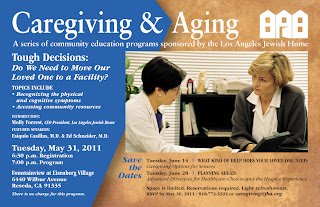 Just like Heritage Pointe in New Jersey, we recognized that many in Los Angeles want information regarding the best options available for aging loved ones. To better serve that need, the Jewish Home is hosting seminars on the various aspects and options surrounding aging and eldercare.
They are all free of charge.
The second event in our series is coming up the Tuesday after Memorial Day. It will cover common physical and cognitive issues associated with aging, how to recognize when help is needed, and the community resources available to you. The event features two experts in geriatric medicine, Dr. Edward Schneider and Dr. Esiquio Casillas. If you or a loved one are interested in issues regarding aging and care options, this is an hour you won't want to miss.
For more information on the Jewish Home's Community Education Series, click here or on the picture of the event postcard.
Labels: Aging, Assisted Living, Baby Boomers, Blog, Community, Cross Post, Education, Long Term Living, Sandwich Generation, Seniors, Series, Staff
Wednesday, April 27, 2011
Nothing to Do? Do Something About It
By Jewish Home Resident Helen Bragar, 84
You can start perking up the doldrums by attending the exercise class with Shelly, the T'ai Chi class with Greg, or the Chair Yoga class with Rosemary (my favorite). Norm and I have been at the Jewish Home for about four months, and we're enjoying ourselves immensely. After thirty or more years of not knitting, under Arts & Crafts Director Radka Falk's care and supervision, I've already made two baby blankets for two great-grandchildren. We knitters and crocheters have a great time joking, laughing, and/or gossiping any day of the week — except Shabbas, of course. If you don't have plans to make something for your family, fabulous Radka will find something for you to do. Her favorite words, "Keep knitting," are heard at least five times a day. Norman has returned to painting after twenty-three years. Now it's hard to keep him away from his easel. He has completed two paintings and has three others in the works.
The volunteers who work in the Arts & Crafts room are amazing. For knitting on Monday there are Sandy E., Sue Madeline, Bernice, Laura, and Marlene. For the artists on Tuesday, there is Beverly, who teaches, plus Sylvia, Iris, and Lucille. For knitters on Wednesday there is Sandy K., who teaches, plus Minnie Mollie, Shirley, Esther, Joanne, Leigh, and Nan (who brings luscious desserts for the class). For the Thursday Ceramics class there are Charo, Rose, Joan, and Elsie. And on Friday mornings, there is Radka for baking delicious mandel broit that is sold in the dining room.
Activity Director Caryl Geiger heads our Drama Group, our Choir, wonderful memory classes, and is in charge of lunch, movie, theater, and museum outings, as well as obtaining wonderful entertainers for Sunday afternoons. She also arranges get-togethers with school children. It's always refreshing to see and be with smart young people. Different types of fun word, vocabulary, and trivia games are led by our other Activity Director, Jacqui Lewinter. She is in charge of theater and concert outings on Sundays and heads our Chai Journal Committee. Jacqui's in-depth knowledge, coupled with her sense of humor, makes her "Hooray for Hollywood" classes a real crowd pleaser. She also heads the Movie Committee, and most recently added the Library Committee to her schedule.
Then there's the Men's Group, now headed by resident David Glicker, which offers monthly discussion meetings as well as lunch outings and other outside activities such as recently attending a taping of "Wheel of Fortune."
You are missing a wonderful experience if you don't spend Thursday mornings with Joel Lish. Joel, a former music teacher, is an accomplished viola player who has unlimited knowledge about composers, the history of music, and performers. he spends close to an hour playing and then showing either a movie or an opera on the screen. Sometimes he invites other musicians to perform with him and has performed with his orchestra on Sunday afternoons.
Not to be missed are the informative lecture/discussion sessions led by Rabbi Sheldon Pennes and Rabbi Rita Hertzberg. There is a Yiddish Group led by volunteer Murray Kaplan, and, of course, there's Bingo several times a week hosted by residents Ira Durlester and Jeanette Schlesinger, or Ellis Simon, or sponsored by outside organizations.
If none of the above can get you involved, you can always scrounge up players for mah jongg, bridge, Rummikub, gin rummy, Scrabble, or backgammon on your own. There are probably some activities which I am unaware of and left out, or try a new one that you've never tried before. Please get yourself out and do something. Socializing has been proven beneficial to us senior citizens.
 |
| Helen & Norman Bragar |
Labels: Activities, Arts and Crafts, Bingo, Bragar, Caryl Geiger, Chai Journal, Choir, crochet, Cross Post, Drama, Jacqui Lewinter, knitting, Men's Group, painting, Socializing, T'ai Chi, Volunteer, Yoga
Monday, April 25, 2011
USC Grad Student Covers 99th Annual Passover Seder

In 2011, Passover continues to have special meaning for the Home. Last week, for the 99th year in a row, we celebrated Passover. On the second night, we opened our home to residents, families, and anyone around the community for our traditional Los Angeles Community Seder. Word of this special Seder spread far enough so that USC graduate student Benjamin Gottlieb decided to cover the event in the USC Annenberg School of Communications blog, Neon Tommy.
Check out the video report he made!
Also, take a look the photo album by Andy Holzman of our Community Seder on the Daily News website!
We'd like to extend a huge thank you to Benjamin for stopping by and producing some great footage, to the Annenberg School for Communication & Journalism for including our tradition on their school's blog, and to Rabbi Rita Hertzberg for leading an amazing Seder.
Labels: Andy Holzman, Annenberg, Benjamin Gottlieb, Blog, Community, Cross Post, Daily News, Hertzberg, Media, Neon Tommy, Passover, Pesach, Photos, Report, Seder, Seniors, USC, Video, Vimeo
Thursday, April 21, 2011
My Favorite Part of the Week

By Esther Berlin
The best part of the week for me is Friday evening at the Jewish Home. I shall never forget my first Sabbath here, six and a half years ago. I walked in for dinner and was unprepared for such a change in the dining room. It was obvious that something special was about to happen. Tables were set with white linens and each place had a glass of wine, a small challah, and flowers. Seeing this beautiful sight, tears of joy ran down my face. I realized how much I had missed celebrating Shabbos. It had been a long time since I made the same preparations at my home on Fridays. Once my two children went off to school and I was alone, I stopped our family's tradition of reciting the prayers and lighting the Shabbos candles.
Now, each Friday that I am able, I go to the Synagogue to say a special prayer for my friends and family who are ill. The Mi Sheberakh seeks physical cures as well as spiritual healing, asking for blessing for all human beings. Celebrating Shabbos with Rabbi Rita Hertzberg is very special for me. Her soft, lovely voice is very soothing and I find myself relaxed, peaceful, and calm. I particularly enjoy singing the Kiddush Motzi when everyone joins in. It seems that all who participate are filled with joy. In the dining room, Rabbit Rita always provides a helpful explanation about the various Sabbath rituals. And then to top it all off, we have that wonderful big bowl of delicious matzah ball and chicken noodle soup! I feel so blessed to be living at the Jewish Home where we observe the traditions of our faith each week.
Labels: Activities, Around the Home, Berlin, Chai Journal, Cross Post, Friday, Hertzberg, Judaism, Kiddush, matzah ball soup, Mi Sheberach, Mi Sheberakh, Prayer, Sabbath, Shabbat, Shabbos, traditions
Monday, April 4, 2011
Al Martinez: A guiding hand in a hard time

By Al Martinez, Columnist
The came like an army of saints, sometimes in multiples and sometimes one at a time.
Their mission was simple but compelling: to get us through a time of grief and anxiety.
I sing today of the Skirball Hospice program, medical personnel and volunteers working out of Encino to bring comfort to the dying and their families, in their homes, in rest homes or in hospitals.
They came to our house when doctors and chemo and machines could do no more for our daughter Cindy, who died last week of cancer.
Their job wasn't to keep her alive but to ease her gently into heaven without pain or the discomforts that often attend a person's last days. They bathed her, medicated her, prayed for her and held her hand.
One can imagine that kind of caring on a battlefield where a solder lay dying of his wounds in the blood and dust of combat, and being cared for by a medic or a hospital corpsman, because cancer too is a ruthless and mighty enemy with killing fields of its own.
The concept of hospice care is rooted in the 11th century as an element of moral compulsion to tend the terminally ill. Skirball Hospice began in Los Angeles in 2001 as a program for the Jewish Home funded in part by the Skirball Foundation. Its services are offered to the terminally ill and families 24 hours a day, seven days a week. Caring never sleeps.
We knew of them from Cindy's doctor, who recommended that she be placed under home hospice care, which is what she wanted, close to the things she loved, including three cats, Tigger, Sarah and Star, who rarely left her side.
A social worker came first, explained the insurance-covered, nondenominational program and then was followed by a multicultural army of nurses, assistant medical personnel, bathers, various other attendants and a rabbi. They were African-American, Asian, Latino, Russian and Caucasian. It didn't matter to them what our ethnic mix was. It never matters at Skirball.
Then came the drugs at various times, the morphine and tranquilizers and whatever else was required to sedate our daughter in her final weeks and to keep her free from pain. There came a hospital bed, too, a portable toilet, oxygen and items I've probably missed in the bustle of the process.
Some staff members appeared in person periodically and others as needed, responding to telephone calls deep into the night. They were there for us all in the final days of Cindy's life, holding our hand as well as hers.
When it became clear that the final moment was approaching, they sent a woman to bathe her and sit by her side until the night and the essence of Cindy merged at 1:35 a.m. I will be ever grateful to the hospice group members for the grace and gentility they displayed in guiding her into eternity. They are special.
Al Martinez writes a column on Mondays and Fridays. He can be reached at almtz13@aol.com.
Read the original column here.
Labels: Al Martinez, Cancer, Caregiving, Cross Post, Daily News, For the Spirit, Hospice Care, Jewish Home Services, medical staff, nurses, Palliative Care, Skirball Hospice, Staff, Volunteer
Thursday, March 31, 2011
A Jewish Home Resident's Opening Day Streak
"When the Dodgers came out in 1958, I became a Dodgers fan and went to the first Opening Day at the Coliseum," Berkson said. "Baseball was a good reason to go out. I bought season tickets the year Dodger Stadium opened [1962] and have had them every year, but gave them up this year because it's gotten hard for me to do. I guess I'm a lifetime fan -- I'm 95 years and still going."This isn't the first time Netti's dedication to her home team was noticed by the media. Prior to attending her 50th opening game in 2007, she was covered by both the Daily News and the Wall Street Journal.
Nettie is one of the many remarkable residents here at the Jewish Home.
 |
| Nettie Berkson and family with Dodgers owner Frank McCourt in 2010. |
Labels: Cross Post, Daily News, Dodgers, Nettie Berkson, Opening Game, Remarkable Residents, Residents, Sports, Staff, Wall Street Journal
Wednesday, March 30, 2011
You’re in Good Company ~ Famous Caregivers
Maria Shriver helped cared for her father, who suffered from Alzheimer’s, and has become a champion of Alzheimer’s Caregivers. Her journalism career began with KYW-TV in Philadelphia, Pennsylvania, but she soon moved up to the National News and later gained a different sort of fame when she married Arnold Schwarzenegger. The former First Lady of California has been a lifelong advocate for people with intellectual disabilities and recently co-authored an Alzheimer’s study with the Alzheimer’s Association.
Princess Yasmin Aga Khan cared for her mother, Rita Hayworth, who was suffering from dementia. Yasmin is internationally recognized for her advocacy work promoting awareness of Alzheimer’s Disease.
Steve Slater cared for his father, who suffered from Lou Gehrig’s disease, until his death. In 2010, while caring for his mother who suffers from Lung Cancer, Steve achieved national notoriety for quitting his job as a JetBlue Flight Attendant in spectacular fashion.
Susan Boyle was the primary caregiver for her elderly mother until she passed away at the age of 91. In 2009, two years after her mother passed away, Susan appeared on Britain’s Got Talent and gave a performance of “I Dreamed a Dream” that made her an International Sensation overnight.
Rosalynn Carter helped care for her father when he was diagnosed with terminal leukemia and has since cared for several family members, including her late mother who died in 2000 at the age of 94. The former First Lady of the United States has even authored a book on Caregiving entitled, Helping Yourself Help Others – A Book for Caregivers.
Can you think of Famous Caregivers that we’ve missed? Let us know in the comments and we’ll add them to the list.
Read the original blog post.
Labels: Alzheimer's, Caregiving, Cross Post, Dementia, Elder Depot, Eldercare, For the Spirit, Senior Care, Staff
Tuesday, March 22, 2011
Good Form: On the strong and balanced side
By Karen Voight

When your core is strong, daily activities become easier and you'll get more from your exercise routines as well. Remember to incorporate this straightforward yet challenging move for a more balanced practice.
Begin on your hands and knees. Turn to the side and position your right hand directly below your right shoulder and your right knee below your right hip. Straighten your left leg with your left foot flat on the floor, toes and knee facing forward. Reach up with your left arm so it is above your shoulders. Engage your abdominals and move your tailbone in toward your body to avoid over-arching your lower back. Look up to the ceiling and pause.
Keeping your hips and shoulders stacked, push through your left heel and lift it to hip level. Concentrate on maintaining your balance with minimal movement in your torso. Hold this position for three to six breaths. Then lower your leg, come to all fours and repeat on the other side.
Voight is the creator of a line of fitness DVDs, including "Full Body Stretch" and "Ballet BodySculpt."
Read the original article.
Labels: Activities, Balance, Cross Post, Fitness, For the Body, Los Angeles Times, Staff, Voight
Wednesday, February 23, 2011
Feeling Sporty? Popular Activities for Seniors

Freshwater Fishing- Fishing can offer peace and tranquility, along with working the muscles in your arms and torso.
Labels: Activities, Aging, Bowling, Cross Post, Fitness, For the Body, Golf, Health, Senior Living, Seniors List, Sports, Staff, Swimming, Walking
Friday, February 18, 2011
New Advice on Preventing Falls
By Karen Stabiner
 |
Robert F. Bukaty/Associated Press |
The earlier guidelines did not single out any particular exercise regimen and endorsed prescription reviews only for patients taking more than four medications.
Exercise is essential for any older person who can manage it, according to Dr. Mary Tinetti of the Yale University School of Medicine, a chairwoman of the panel that issued the new guidelines. Tai chi gets the nod because several trials have suggested that it seems to help reduce the risk of falling, she said, although it is possible that other forms of balance training work just as well.
Greg Fuller teaches tai chi at the Jewish Home in Los Angeles. “The basic underlying philosophy is that balance is everything,” he said. Most important for his students, whose average age is 90, tai chi involves small, slow, controlled motions.
“With beginners, we spend a lot of time working while seated, bringing attention to the proper alignment of the pelvis, chest and head,” said Mr. Fuller. Once that is accomplished, “finding strength and balance while standing is much easier.”
Even then, many students work standing just behind a chair. “The presence of the chair back within reach gives them a sense of security and confidence,” Mr. Fuller said. “They forget about the possibility of falling and concentrate on the movements.”
Confidence is important to fall prevention, according to Dr. Tinetti, who said that fear of falling can itself lead older people to cut back on activities they used to enjoy. The less they do, sadly, the less they eventually are able to do.
The geriatrics groups also have long recommended that the medication regimens of older patients be reviewed and, if possible, scaled back. Earlier guidelines called for reviewing medications only if a patient takes more than four. This time around, researchers say that all older patients ought to have their doctors review their prescriptions for any that might increase the risk of falling.
“The evidence is strongest that medications that affect the brain — these include antidepressants, sleep medications and medications for anxiety — increase the risk of falling,” said Dr. Tinetti. “There is also a suggestion, not yet proven, that narcotics and some blood pressure medications may increase the risk of falls, as well.”
The updated guidelines distinguish between a fall that requires intervention and one that might be a isolated incident. The updated criteria for getting a risk evaluation are:
- An elderly person worried or frightened by a fall.
- Two or more falls in the past year.
- One or more falls with injury.
- Repeated difficulty with balance when walking.
Read the original blog post here.
Labels: Aging, Balance, Cross Post, Falling, Fitness, For the Body, Health, New York Times, Stabiner, Staff, T'ai Chi, The New Old Age
Tuesday, February 15, 2011
Senior Love
By Ellis Simon

Both Genia and Irving were given rooms in the Weinberg Building. As Irving was walking down the hall one day, he passed by Genia's room. He saw the door was open, and since he had noticed Genia before, he walked into her room and they started to talk. As they say, "Irving was smitten." They started to see each other every day, and after about a year, Irving popped the question. (Genia made sure to tell me that he did not get down on one knee.) They then started to make arrangements to get married here at the Home. The big day arrived, and with the synagogue packed with family and residents, they said their "I Dos" under the chuppah. The wedding reception was held in their favorite place, the Arts & Crafts room. Both Irving and Genia spent many hours in this room, so it was an appropriate place for the festivities.
They have five children between them, and five grandchildren. Irving's children live in California, and Genia's daughter and grand-daughter live in Arizona, and her two sons live in Northern California. Before coming to the Home, Genia was a dressmaker, and Irving worked for the government in the ballistic missile field. I really believe this couple was made for each other, but it took them a long time to find it out. They are a lovely couple.
Labels: Around the Home, Burman, Chai Journal, Couples, Cross Post, Eisenberg Village, Love, Mandel, Marriage, Residents, Romance, Simon, Staff
Friday, February 11, 2011
Great Sex at 100? Who Knew? Happy Valentines Day [VIDEO]
By Ilana Angel

Sex is the one thing that separates a relationship from all others. It is special, important, required and the single greatest thing about being a grown up. At 44, I have reached a level of comfort when it comes to sex. I have no hang ups talking about it, or embracing my body so I can enjoy it. Sex is a great thing, and it took me a long time to get to this place.
There is no longer a need to suck in my stomach, or wear lingerie that covers parts that have relocated to new positions. I may not have the greatest body, but it’s mine, I know it, and I am an expert at operating it. Who would have thought that at 44 I would feel sexier than I did when I was 24? It’s a beautiful thing, and it’s being wasted by my lack of sex.
Just when I was about to pour myself a glass of wine, and enjoy an afternoon pity party, I was sent a video that has changed my perspective. It turns out there is no need to panic. Even if it takes me a little longer to meet someone worthy of having sex with, I will still be able to have and enjoy sex. Whether I’m 45, God willing, or 100, God willing, sex is going to be great.
The Los Angeles Jewish Home has created a special video about finding love. It introduces us to Dorothy and Harry, Jeanette and Ira. These love birds are in their 80’s, 90’s and yes 100 years old, and they are having sex! God Bless these crazy kids, and bravo to them for openly talking about their sex lives. I think they are adorable.
I could still have a pity party because there are people in their 100’s having more sex than me, but instead, I am going to think positive and take comfort in knowing each day I get older does not mean I am one day closer to never having sex, because sex is coming. Eventually. I will impale myself if my next sexual encounter happens when I’m 100, but it’s coming.
According to the Los Angeles Jewish Home, “being in love can boost self-esteem and decrease depression and anxiety. Being happy in a committed relationship can improve your immune system, leading to fewer colds and visits to the doctor, and can even lower blood pressure.“ Sex is a great thing that also happens to be great for you. Whoo hoo!!!
Story continued after the video. ED. NOTE: This video really gets cooking at the 2 minute mark.
I hope that everyone has love on Valentine’s Day. Whether you believe in the holiday or not, it’s a day to embrace love. I embrace love every day, which is both a blessing and a curse. Maybe I need to focus less on love and more on sex? Maybe instead of dating online, or getting set up by my friends, I need to hang out at the Los Angeles Jewish Home.
I’m not going to date a resident, but perhaps I could meet a son, grandson, or doctor, who is also inspired to find love by these love stories. Mazel Tov to these lovely couples, and congratulations to The Jewish Home for this brilliant piece of marketing. I’m still having wine, but instead of a pity party, I am toasting to finding love, and knowing it will come if I keep the faith.
Read the original blog post here.
Labels: Couples, Cross Post, Ilana Angel, Jewish Journal, Love, Residents, Romance, Sexuality, Staff, Valentine's Day, Video