
- Blog Home
- Recent Posts
- Sending Love and Supplies to Children in Need
- Generation to Generation Society: Making Waves in ...
- The Joyce Eisenberg-Keefer Medical Center Welcomes...
- The Meaning of the High Holy Days
- Save the Date! Celebration of Life: Reflections 2015
- Rabbi Karen Bender Joins the Journey for Justice
- Hebrew Union College Students Visit the Home
- Residents Enjoy Films at the Laemmle Theater
- The Joyce Eisenberg Keefer Medical Center Centenar...
- Save the Date for the Walk of Ages XVI
- Post Categories
- Posts by Author
- Blog Archives


Los Angeles Jewish Home's Blog
Tuesday, October 1, 2013
Based on My Sermon for the First Day of Rosh Hashanah — Letter from the Rabbi
Wouldn't it be better to do it the other way around? Shouldn't we first seek atonement, and then — cleansed and joyful — enter into the celebration of the beginning of a fresh new year? Certainly that would make good sense; but there is another way of looking at the sequence, which adds extra power to these High Holy Days.
A major aspect of Rosh Hashanah is celebrating the creation of the world. As the prayer book says, Hayom harat olam — today is the birthday of the world. So let us on this day contemplate and celebrate the beauty and wonder of the world God has created:
- A world where we can look after our environment, so that the atmosphere is free from pollution, the air is clean, and the seas are pure.
- A world where rain is abundant in its due season; where rivers flow full but safe within their riverbanks, irrigating the land and giving human and animal alike plentiful and pure life-giving water.
- A world where people and nations pursue justice, so that every person in the world has his or her share to eat, access to drinking water, and safe shelter.
- A world where rulers and governments are wise and just, assuring a decent and good life for all their citizens.
- A world where women, and people of all sexual orientations and races and religions, are treated honorably and with equality.
- A world where immigrants seeking safety and a good life are respected and enabled to play their part in society.
- A world where war is unknown, as nations know the value of seeking peace and cooperation with their neighbors.
- A world where people have an overwhelming desire to spread happiness and to be compassionate and protective to others.
I understand the creation story as God's gift of a potentially wonderful world. Just as we human beings, created in God's image, have the potential to be so much more than we often manage to be, so too the world is only a beginning of what it could be. Let us, on this Rosh Hashanah, this birthday of the world, celebrate that potentially wonderful world, with an honest recognition of all the ways it falls short.
At this season, we are not only celebrating, we also are starting the process that culminates on the day of Atonement, a process of looking at what we have achieved, both personally and collectively, and what we have failed to achieve; what we have done for the good of the world, and the negative things we have done that contribute to the world's shortcomings. Every act we do or don't do makes a difference to the health of the world we are passing to our children and grand-children.
As well as enjoying the good and the love in our lives, and wishing each other a new year filled with sweetness and good, we can hold in mind that idealized picture of the world, and know that it is within the power of every one of us to move this imperfect world an inch or two towards that beautiful potential.
 Rabbi Anthony Elman is the Skirball Director of Spiritual Life at the Jewish Home and also serves as Rabbi of the Home's Grancell Village campus. His professional background is multifaceted, encompassing the fields of law, social work, and psychotherapy. Rabbi Elman has been with the Home since his ordination and graduation from the Academy for Jewish Religion-California in May 2007
Labels: Elman, For the Spirit, High Holidays, Letter from the Rabbi, Rosh Hashanah, Yom Kippur
Tuesday, May 14, 2013
How Do We Turn Life Around? — Letter from the Rabbi
We may try to find a way forward, perhaps by meeting with a psychologist or some other wise listening person, perhaps by prayer, perhaps by throwing ourselves into activity. Over recent weeks, through my teaching in preparation for the festival of Shavuot, I have been inspired by another kind of key to unlock the gates that seem to keep us trapped.
Let’s look at the miserable situation of Naomi, as told in the biblical Book of Ruth (read every year on the second day of Shavuot). She has left Bethlehem in the Land of Israel, together with her husband Elimelech and their two sons Machlon and Chilion, and settled in the Land of Moab. But in the months and years that follow, disaster strikes – again and again and again! First Naomi’s husband dies. Her sons marry Moabite women, Orpah and Ruth, but after some years both sons die, and Naomi is left with only her daughters-in-law.
It is not hard, I think, to imagine just how desolate Naomi is, having lost her husband and both her sons. Naomi feels that life in Moab has nothing to offer her now, and decides to go back to Bethlehem. She tries to persuade her two daughters-in-law, Orpah and Ruth, each to return to her family home, where they might marry Moabite husbands, and find security. At first both young women insist on staying with Naomi, but in the end Orpah gives away and reluctantly returns to her family home.
As for Ruth, her words must be among the most beautiful expressions of love and loyalty in all the Bible, indeed in all literature: Wherever you go I will go and wherever you stay I will stay. Your people shall be my people and your God my God. Wherever you die will I die, and beside you will I be buried. How can Naomi argue against such love and such absolute determination?
Why does Ruth make such an astonishing and moving pledge? She can have no expectation of reward, and must know that Naomi is right: Ruth would have a much better chance of security and happiness if she returns to her family and lives among her own people. What is so beautiful about Ruth’s pledge to Naomi is that it is pure giving, pure love.
So the two women go on to Bethlehem together, where the turns of the story lead Ruth to a good man called Boaz. Ruth and Boaz marry, and Ruth gives birth to a son – the grandchild Naomi never expected to hold. Through that son, two generations later, comes the great King David. How did such misery, as Naomi had experienced in Moab, turn to such nachas (joy)?
Surely it is Ruth’s selfless kindness towards her mother-in-law, with no expectation of reward, which brings about the change in the universe of these two women. Is there a lesson for us? Can our own selfless generosity change the world we live in?
When I raised this in my discussion groups, many residents were absolutely clear: yes we can change our world for the better; we can turn our life around. Some said it is because we change when we are particularly kind to others; others said that our own generosity can make others treat us better. I myself do believe that a selfless act of kindness and giving, without any expectation of reward, changes the universe for both the giver and the person who receives the act of kindness. We are no longer stuck in misery: we are in a new world.
Chag Shavuot Sameach - Happy Shavuot!
Rabbi Anthony Elman is the Skirball Director of Spiritual Life at the Jewish Home and also serves as Rabbi of the Home's Grancell Village campus. His professional background is multifaceted, encompassing the fields of law, social work, and psychotherapy. Rabbi Elman has been with the Home since his ordination and graduation from the Academy for Jewish Religion-California in May 2007Labels: Book of Ruth, Elman, For the Spirit, Letter from the Rabbi, Naomi, Shavuot
Thursday, April 25, 2013
What Do We Do With Our Hurts — Letter from the Rabbi
I think most of us can recall all sorts of ways we've been hurt, in our feelings, our body or our pocketbook. What do we do with these hurts? For some, what comes naturally is to take them out on others – to damage others like we've been damaged. Others may see the best thing to do is put aside our hurts (if not quite forgive and forget), and get on with our lives.
Because of a Torah reading this month that contains that powerful principle, Love your neighbor as yourself (sometimes called the Golden Rule), I have been thinking about a famous variation of it. Some of you may be familiar with the story about Hillel, the great Jewish sage who lived two thousand years ago: a non-Jewish person came before Hillel wanting to be converted, on condition that Hillel would teach him the whole of Torah while the man was standing on one foot. Hillel said to him, "What is hateful to you, do not do to others: that is the whole Torah; the rest is commentary; go and learn it."
What Hillel is doing here is taking the Golden Rule and making it much easier to understand and use. Love your neighbor as yourself is a wonderful principle from which all other moral rules derives, but it is not always easy to know how to apply to our lives. However, if we can hold in our minds the words of Hillel – What is hateful to you, do not do to others – we have a ready guide to behavior. For this principle tells us what to do with our own feelings about how we like, or hate, to be treated, and what to do with all those hurts we have suffered: not to put them aside, not to take them out on others, but instead to use them to guide our life and our actions for the good.
For instance, if I know how horrible it was for me to be teased or subjected to cruel words, I must never do that to others. If I recall the hurt I felt as a child being called a "dirty Jew" (thankfully that was not a frequent happening), then that must guide how I think about other peoples, or religions, or races, or nationalities: not ascribe negative characteristics to those groups, and not treat members of them badly because of those imagined characteristics.
If I have felt ignored when I was in need or distress, or when I had something to say, then I need to be especially careful not to ignore others. If I have found my reputation damaged because people have been gossiping about me, I must guard against gossiping about others. Of course there are many wrongs that I personally haven’t suffered, but I can imagine how much I'd hate the experience, and that should be a warning bell for me not to cause such wrongs to others.
Hillel's demand that we use our own experience and feelings as a guide to action is reflects a teaching found frequently in Torah, about how we should treat the "stranger" – i.e. the immigrant from another land who lives amongst us. The Torah teaches: "When a stranger resides with you in your land, you shall not wrong him. He shall be to you as one of your citizens: you shall love him as yourself, for you were strangers in the land of Egypt." We are to use our own bad experiences as strangers (and slaves) in Egypt – or wherever we have lived as a minority community in a country not our own – to ensure that strangers among us are treated much better.
While this is how Torah tells us to treat the stranger, Hillel's teaching, What is hateful to you, do not do to others, is a powerful reminder about all our actions. Our experiences, bad experiences in particular, are to be central to our moral stance in the world; and we cannot claim to be living ethically if we ignore those experiences in how we treat others.
Rabbi Anthony Elman is the Skirball Director of Spiritual Life at the Jewish Home and also serves as Rabbi of the Home's Grancell Village campus. His professional background is multifaceted, encompassing the fields of law, social work, and psychotherapy. Rabbi Elman has been with the Home since his ordination and graduation from the Academy for Jewish Religion-California in May 2007Labels: Elman, For the Spirit, Hillel, Letter from the Rabbi, Love your neighbor, Torah
Monday, February 18, 2013
Meaning and Transformation — Letter from the Rabbi
I’ve noticed how residents talk with delight about the way that first meeting came about, while their wedding itself hardly gets a mention. That’s true for me too. Just a few days ago my wife and I celebrated the tenth anniversary of the day we met (in Jerusalem). A day like that fundamentally changes the course of one’s life, while a wedding perhaps only confirms a course one has already decided on.
When we say “it was meant to be” or “God intended it” we are expressing our sense that life has meaning that is hidden beneath ordinary circumstances, in coincidences, even in silly mistakes. But why do we think a wonderful happening, like the one that led to a good marriage, is beshert, while we find it harder to say that about a tragedy? When something terrible happens, we are more likely to say God was absent, or God didn’t care, or God doesn’t exist. It would challenge our idea of a good God to suggest that God intended, or wanted, us to suffer hardship or pain.
I would never say to someone suffering loss or illness that God intended this to happen to them. That would be cruel and insensitive, and how can I know, anyway? And yet as we reflect on challenges in our own lives, we may experience trust that there is rightness to what happens, and out of that trust can come positive developments. Is that trust fanciful? That I can’t answer for sure. But my own faith, that there is meaning to the events in my life, has helped me grow from negative happenings, such as illness, so that I bring new changes to my life for the good.
In a few days we will be celebrating the Jewish festival of Purim, which is based on the Book of Esther. Now we all know that the Bible is largely about God, but in this strange biblical book, God doesn’t get a mention. The characters go through their events with the most human mix of silliness, chance, ambition, revenge, fear and courage. Yes, just like we tend to see our own lives.
But the name “Esther”, even though it is derived from a Persian name, connects to the Hebrew word for hidden. It is a hint that even in that very human Purim story, there may be meanings (and God) hidden under the everyday events. This is certainly what our Sages taught. In the Yiddish word we are used to, maybe the events – like the young Jewish girl Esther marrying the Persian King – are beshert.
I think this is what her cousin Mordechai believes. When he learns that the Jewish people face destruction at the hand of the wicked Haman, he seeks to persuade Esther not to be cowardly but to risk her life to get the king to save the Jews. Mordechai says, "Who knows if it is not for this purpose that you are here?"
I think it is that question that prompts Esther to overcome her fear, to wonder if perhaps it was beshert that the king divorced his previous wife and chose Esther to be his new wife. Out of those events grew the opportunity for Esther to save her people. She rose to the occasion, transforming both the situation and herself. Instead of being someone who things happened to, she became a person who made things happen. If we look at the events in our lives as beshert, that we are here at this moment for a purpose, how might we too transform ourselves so that we bring good to ourselves and the world about us?
When we are not making a noise to drown out the name of Haman (who stands for negativity and destructiveness) let’s ponder how Esther can inspire us to new creativity.
Rabbi Anthony Elman is the Skirball Director of Spiritual Life at the Jewish Home and also serves as Rabbi of the Home's Grancell Village campus. His professional background is multifaceted, encompassing the fields of law, social work, and psychotherapy. Rabbi Elman has been with the Home since his ordination and graduation from the Academy for Jewish Religion-California in May 2007Labels: Beshert, Elman, For the Spirit, Letter from the Rabbi, Purim
Wednesday, January 2, 2013
Helping the Spirit to Soar

In fact, Rabbi Rita Hertzberg, the Los Angeles Jewish Home’s Campus Rabbi for Eisenberg Village, believes our spirituality has the potential to expand as the years go by.
"As the body ages and the mind ages, the spirit grows," she says. "It’s the only part of us that doesn’t decline."
Scientists disagree on how and whether spirituality and religion influence health. Some studies have concluded that religious faith increases our ability to cope with illness, disability, loss, and mortality. Others have reported lower blood pressure and depression levels and longer lifespans among individuals with a strong personal faith who regularly attend religious services.
At the same time, some researchers believe there is not enough scientific evidence to conclude that spirituality is associated with health.
But perhaps it doesn’t matter whether the scientific evidence is conclusive. Experiences of residents at the Los Angeles Jewish Home clearly demonstrate that spirituality affects emotional health and quality of life.
"If we can get [spirituality] to kick in and to grow brighter, this becomes a light that can ease the darkness we feel that is natural in the aging process," says Rabbi Hertzberg.
Working with residents, Rabbi Hertzberg and her colleague Rabbi Anthony Elman, the Home’s Jack H. Skirball Director of Spiritual Life and the Campus Rabbi for Grancell Village, have both seen tremendous changes in individuals who have discovered or enhanced their sense of spirituality.
Rabbi Elman recounted the story of one resident who had lost her eyesight quite abruptly. Despite her loss, he said, "She is full of thanks to God for God’s help and to the Home for giving her a place to thrive and for gifts such as having the ability to dress and do other things for herself."
Another resident who was 85 years old and declining rapidly went through the process of having a Bat Mitzvah. She learned verses of the Torah and read them in Hebrew. "It was very meaningful for her and for her family," says Rabbi Elman.
Rabbis Elman and Hertzberg say that there are multiple avenues to spirituality. Certainly religion can be one path. "There's a statement in the Talmud which says that when two or more people study Torah, God is present. I believe that," says Rabbi Elman. "I [also] believe that prayer and a feeling that somehow I'm not alone – that God is with me – can help."
At the same time, he stresses that religion is not the only path to spirituality. "I try to introduce a sense of awe – which I take to mean opening oneself to something greater," says Rabbi Elman. While that may take the form of thanking God for our blessings, says Rabbi Elman, it can also involve marking occasions, such as Veteran’s Day or Martin Luther King’s birthday, where "people can be lifted to feeling and recognizing something greater than themselves."
Music can also be a source of spiritual enhancement. Rabbi Hertzberg says she sings a lot with residents, and that songs can be "a spiritual connection to the past" for them. "I've found music to be an amazingly powerful and spiritual vehicle," she says.
In addition, she believes many residents feel spirituality in their sense of community and connectedness. They may not know anyone when they arrive at the Home, but they soon establish relationships with staff members and other residents.
Whether through prayer, study, music, community, meditation, or other means, humans have the ability to enhance their spirituality at any stage in life.
As Rabbi Hertzberg puts it, "We don’t stop being a spiritual being until we take our last breath."
 Nancy Sokoler Steiner is a freelance writer and author based in Los Angeles. Her work has appeared in Los Angeles Times Magazine, The Jewish Journal of Greater Los Angeles and Lifestyles Magazine, among other publications.
Labels: Elman, For the Spirit, Hertzberg, Rabbi, Religion, Spirituality
Monday, December 24, 2012
Light increases — Letter from the Rabbi
So one of the questions I have been raising with residents is whether our light – the light that shines within us – increases as time goes on. I focused particularly on wisdom. As every resident knows, our memory certainly doesn’t improve with passing years, but wisdom is something that may live on within us quite independently of memory.
Some people said that experience made them wiser. As the years pass, we live through so many experiences, for good and for bad; and of course we all make mistakes, which – in theory – we learn from. One resident joked that she is allowed to make the same mistake twice, but twice is the limit! Another said that she always tries to ask herself: what did I learn from that mistake?
I think she’s right. Experience teaches us to make better decisions in how we live our lives only if we can reflect on what we have been through. For that, we need to know ourselves and what is really important for us. If we don’t, we can re-live patterns that don’t help us at all. We grow in wisdom when experience teaches us to understand ourselves and the world around us; that way, we are more able to make judgments that are good and healthy.
When we see our own goodness and also our own failings, and recognize these in others too, we are better able to face life’s challenges without being filled with negativity. It is my belief that love and compassion for ourselves and for all humanity are major elements in wisdom; indeed they are a basis for the biblical injunction to "Love your neighbor as yourself".
As we talked of the increase in light with the passing years, many residents felt that they were more compassionate than they used to be. Surely that compassion arises out of the knowledge that we human beings all share a certain frailty, all are struggling to do the best we can, and none of us can get it right all the time. Isn’t it true that a wise person recognizes and appreciates that shared humanity?
A growing wisdom many bring a deeper sense of what is important to us. It is interesting that, for many of us, our priorities change during our lifetimes. It is not, I think, just because circumstances change: it is also because we change. When residents talk of what is important to them now, they focus frequently on relationships and, most of all, family.
I was fascinated when one resident talked about the importance of compromise. What she meant was that we can’t always have things just as we want. That is true throughout our lives, but comes to the fore particularly as we encounter new situations, such as aging and disability. If you stick to your old view of how things ought to be, you get nowhere. In the words of one person, a lady who had spent years in Auschwitz: "You have to live life as it is, and thank God every day for your life and blessings". This was a theme for several people, and some noted that not every resident is able to adjust to life as it is.
I asked one person, whom I have known since the time she was still walking with ease, how she had managed her transition to having to use a wheelchair. I knew she would give me a thoughtful response; in fact what she said brought tears to my eyes. She said: "I had to face the truth – the truth of my situation. Once I could do that, the rest was easy." She was putting into words what so many residents know, reminding us that wisdom also involves courage – the courage to shine light on our lives and our situations, and face truths we might prefer to ignore.
Rabbi Anthony Elman is the Skirball Director of Spiritual Life at the Jewish Home and also serves as Rabbi of the Home's Grancell Village campus. His professional background is multifaceted, encompassing the fields of law, social work, and psychotherapy. Rabbi Elman has been with the Home since his ordination and graduation from the Academy for Jewish Religion-California in May 2007Labels: Chanukah, Elman, For the Spirit, Hanukkah, Letter from the Rabbi, Wisdom
Friday, November 30, 2012
What makes a community? — Letter from the Rabbi
And then there are those times when residents express wholehearted appreciation for staff, like when someone at a residents’ council meeting says that, say, Housekeeping or Maintenance or Activities are “wonderful” – and lots of other people agree. Around Thanksgiving, I asked in various groups what residents were thankful for. Top of the list for so many people was the Jewish Home!
It’s interesting to think what this means. We could look at the Home as distinct groups of people, each with their own separate role: those who live here (or receive the Home’s services in other ways); and those who are employed here; those who volunteer their time and energy and skills, and those who donate financially. Yes that’s one way of looking at the Home, but in fact it is much richer than that.
I have been asking myself the question: what makes a community? I believe it is much more than, say, a group of people who live in the same place; or a group of people who work in the same place. A community (just like a family) is held together by invisible bonds – they may be bonds of love and caring; or, just as important, bonds of obligation.
Then we may look at the common purpose that brings a group of people together. The purpose of the Home is to bring the highest standards of care to seniors, in keeping with Jewish values. All efforts are aimed at giving the best to residents and to others who receive the Home’s services. In this way, the Jewish Home is an organization with a purpose. It meets that purpose to a pretty high standard – which is a prime reason residents are so thankful for it.
But the Home is not just an organization; it is also a community. Certainly it is there for the residents, but it also plays an important role in the lives of staff and volunteers and donors (and let’s include those who give their time to serve on the Home’s governing bodies).
All have the potential to give to others, and all have the potential to have their lives enriched by the web of relationships, the obligations and the caring, the warmth and the friendship, the sense of belonging that membership of a community like this can bring.
Some of the employees have been with the Home for 20 or 30 or more years. Some stay in the same jobs over the years, while others take advantage of the opportunity the Home offers to move up to more satisfying or senior roles. Those who work here enjoy their relationships with each other and with the residents; and many experience a fulfillment that comes from being able to contribute to the life and wellbeing of others. And I know how much most of our residents enjoy their connections with the staff and appreciate what they do.
I have just had the privilege of participating in events that gave me a new sense of this Jewish Home family. On the days before Thanksgiving, Rabbi Rita and I co-hosted interfaith services on both campuses for employees of the Home, alongside a Catholic Priest and a Protestant Pastor. I found this coming together of staff members and clergy from different backgrounds very moving.
Here at the Home, people fill different roles – residents, nurses, dietary or maintenance staff, administrators, and many more – and come from many backgrounds and traditions. What I have come to see more clearly than ever before, is that there is so much more that unites us than divides us. Together, we are a community, and I am thankful to be part of it.
Rabbi Anthony Elman is the Skirball Director of Spiritual Life at the Jewish Home and also serves as Rabbi of the Home's Grancell Village campus. His professional background is multifaceted, encompassing the fields of law, social work, and psychotherapy. Rabbi Elman has been with the Home since his ordination and graduation from the Academy for Jewish Religion-California in May 2007Labels: Community, Elman, Jewish Home, Letter from the Rabbi
Tuesday, February 28, 2012
The Courage to Face Life - Letter from the Rabbi
When the Israelites complain to Moses – Why don’t you leave us alone, to remain in Egypt as slaves? – they want to stay in the world they know, rather than take all the risks of freedom. Freedom carries the dignity of making choices, and the possibility of good and new things in our lives, but also it means we live without knowing what tomorrow brings. Willingness to face the uncertainties and the difficulties of life, as well as its possibilities, is what courage is all about. The alternative, in the words of one resident, is: Just give up, stay in bed, and pull the blankets over your head.
Does growing older call on us to have courage? A resident answered: Yes we need courage, because we never know what’s going to happen. Perhaps she was thinking about the sudden change in health she had recently gone through – without a negative word! Another resident told us her first words on waking each morning: No surprises today please!
It is not just the unknown. Some residents live in almost constant pain or discomfort; others get on as best they can despite physical difficulties. Most know the loneliness of life following the death of their long-time husband or wife. As I see how the majority of residents make the best of life without complaint, it strikes me that courage is indeed an important factor in making senior years a positive time of life. Here at the Home, the staff does a wonderful job in making the life of residents as comfortable, dignified and enjoyable as possible. What is sometimes overlooked is that the residents do a wonderful job too. For me, to see such courage is both humbling and inspiring.
The Torah expresses courage as faith in God. For instance, when the Israelites are facing the Red Sea, with the Egyptian army coming up behind them, they initially complain to Moses who tells them: Have no fear, stand by and watch how God will save you! While many people have courage which is not based on faith is God, there are others for whom faith can be a source of courage. Psalm 23 puts it: Though I walk in the valley of the shadow of death, I will fear no evil, for You are with me. A sense that one is not alone can give great strength.
I have very great respect for those who came through years in the Nazi death camps or work camps. I know from my reading that not everyone kept their determination to survive; some just gave up. I am not surprised, so I asked the Holocaust survivors in my groups what gave them the courage to keep going. All without exception told me their faith was very important to them. One said his recitation of psalms sustained him. Another said she felt God by her side as she volunteered for work – which turned out to be her route to survival. Another said her religion was important to her, but she also believed a person’s childhood upbringing made a big difference. She herself had had a very poor childhood, and that difficult time gave her the strength she needed to face the enormous challenge of life in the camps. I understand that; although we all want an easy life, it is very often difficult experiences that strengthen us to face even greater challenges in the future.
We talked a little about the courage to face death. One resident was sad about the relative shortness of the time still left for her, wishing she had achieved more. But not one person expressed fear about the future.
Perhaps that is why I love being a rabbi at the Jewish Home: while I am no longer young myself, I work amongst my seniors and my teachers, who help me to think that maybe I too will be able to face all the uncertainties and hardships that lie ahead. For that I am grateful.
Rabbi Anthony Elman is the Skirball Director of Spiritual Life at the Jewish Home and also serves as Rabbi of the Home's Grancell Village campus. His professional background is multifaceted, encompassing the fields of law, social work, and psychotherapy. Rabbi Elman has been with the Home since his ordination and graduation from the Academy for Jewish Religion-California in May 2007Labels: Aging, Bible, Courage, Death, Elman, For the Spirit, Holocaust survivors, Inspiring, Israelites, Jewish, Judaism, Letter from the Rabbi, Moses, Rabbi
Tuesday, January 17, 2012
Reflections on Life and Death
In the midst of the towering trees and the fallen logs, it struck me that there is no clear distinction between what is alive and what is dead. Rather, there is an astonishingly complex pattern of interdependence and regeneration. The creatures and the plant life need each other, and the so-called “dead” branches and leaves are part of that pattern. They are far from useless: they provide home and nourishment to insects and small animals and other organisms, and gradually they break down to fertilize the soil, giving new growth, new life. In fact they are essential to the life and health of the new trees.
In that way, what is fallen seems as alive as the tall majestic trees. Certainly in the grand scheme of nature, the fallen, the “dead”, seem just as valuable. How odd that we human beings don't regard our dead as alive and valuable and nourishing! But that's exactly what they are.
In the Jewish tradition, we place great value on life: this life. It is not, as in some cultures, merely a preparation for a future life after death. This life, what we do in it, how we behave towards others, what we do to help bring about a better world – these are what count.
So once we die, do we become irrelevant to the rich pattern of life? Do we lose all value? That is how many people think about death, but I believe they are wrong. Just like those fallen trees and branches in the forest, what we have been in our lives will continue to affect those we leave behind, contributing to their lives.
Let me give an example. I continue to be inspired by the man I still regard as "my rabbi", several years after his death. He was a deeply spiritual man, who would speak and sing to God with all his heart and soul, but he combined that with a passion for changing the world for the good. His example taught me that spirituality – our relationship with God – has little value unless it is reflected in how we try to bring good unto the world. Like a great fallen tree in the forest, my rabbi continues to affect the lives of so many people who knew him or studied with him.
It is not just the “big” people in our lives (like parents and significant teachers) who make a lasting difference. Don’t you find that when someone shows trust in you, it adds to your confidence? Or when someone laughs at you, or treats you badly, it makes you feel smaller and less confident in the world? Just think back on the love your parents gave you, or some act of kindness or nobility shown by a friend – how that made you a better person. Whatever we do in our lifetimes affects others, and that effect remains after we have gone.
Where do these reflections lead me? On the one hand, I feel I must try to live up to the good bequeathed to me by so many who have gone before. After all, my life has been enriched enormously by countless people who are no longer alive – not just people I knew, but also people who died even before I was born, like all those men and women over the centuries who contributed to Jewish life and culture.
On the other hand, I think it’s important for me to be aware that every act of mine, for good or for bad – like a leaf on the floor of the rainforest – will continue to do its good or its bad long after my physical death.
I have come to realize that I want to leave behind a real (even if invisible) legacy for good in the lives of others. When my earthly life comes to an end, my hidden influence will continue. And I want that continuing influence to be for the good.
Don’t you feel the same way?
Rabbi Anthony Elman is the Skirball Director of Spiritual Life at the Jewish Home and also serves as Rabbi of the Home's Grancell Village campus. His professional background is multifaceted, encompassing the fields of law, social work, and psychotherapy. Rabbi Elman has been with the Home since his ordination and graduation from the Academy for Jewish Religion-California in May 2007
Labels: Costa Rica, Death, Ecosystem, Elman, Influence, Jewish, Judaism, Life, Rainforest
Wednesday, November 23, 2011
Letter from the Rabbi – Open your eyes and be surprised!
At the urging of his wife Sarah, Abraham sends away his concubine Hagar and her child Ishmael (Abraham’s elder son). Mother and child set off into the desert carrying food and water, but before very long, the water bottle is empty. Hagar cannot bear to see her son die, so she puts him under a bush, goes to sit some distance away, and weeps bitterly. As for us, at this point in the story we have feelings of distress, of doom. There is no future.
Let’s leave that story for a moment and look at the other – the horrific tale we call the Akeda, the binding of Isaac. We are told that God tests Abraham, instructing him to take his beloved son Isaac and sacrifice him as a burnt offering. We watch with horror as Abraham prepares for the journey, without a word of protest. He and Isaac arrive at the designated place. Abraham builds the altar, binds up Isaac and lays him on the altar; he takes the knife and makes ready to slay his son.
Again, as in the story of Hagar and her son Ishmael, we feel so helpless, as it seems the story must take its inevitable, painful, course. It’s partly that in each case, the adult sees no alternative. Each is blinded to other alternatives. Hagar is wailing as her son faces certain death. Abraham is determinedly doing what he believes is the will of God, seemingly unable to shift course and put life before death.
I believe we have all had moments when we feel there is no way forward. A sense that life – real living – has come to a stop. But in these stories new inspiration and new life intervene.
God interrupts Hagar’s wailing and tells her to go back to her son, promising that the boy’s descendants will become a great nation. Well, God speaking is all very well, but let’s not forget Hagar has run out of water. So although she must be heartened by God’s words, she still cannot see a way out of the deathly present, into a life-full future. Isn’t it true for us too? When we’re stuck, we just can’t see a way forward.
So God intervenes in a different way. He “opens Hagar’s eyes”. To her (and our) surprise, where Hagar has seen only desert, she now sees, just a short distance away, a spring of fresh water. She fills the water bottle, goes to her son, and gives him to drink.
Let’s return quickly to that other story. We left Abraham, knife in hand, about to slay his son Isaac, bound on the altar in front of him. Here again, it is God’s voice that interrupts Abraham’s set path, calling to him not to kill his son, not to harm him in any way. God says that, as Abraham has shown his willingness to listen to God’s word, Isaac (like Ishmael in the other story) will be the father of a great nation.
I picture Abraham as still paralyzed, unable to take a step away from the brink, unable to make the move towards life. He still needs to see a way forward. We read then that Abraham lifts up his eyes and sees a ram caught in a thicket by its horns. That’s when he is able to change course: he sacrifices the ram instead of his son Isaac.
So each of these stories has a surprise twist that enables the person to “see” what couldn’t be seen before – a spring of water, or a ram caught in the thicket. Suddenly there are possibilities.
I know that sometimes, for instance after the tragic loss of a loved one, or when one is struck by major illness or disability, there may seem no more possibility of rich and valuable life. But I have seen so many residents find new meaning in their lives, new possibilities of richness and joy. Here is a challenge to us all, to be willing to be surprised – to discover that the course of our own story may have a twist we didn’t expect, one that we couldn’t have dreamt of, one that opens a new path to a life of meaning and richness. Let’s just open our eyes!
Rabbi Anthony Elman
Rabbi Anthony Elman is the Skirball Director of Spiritual Life at the Jewish Home and also serves as Rabbi of the Home's Grancell Village campus. His professional background is multifaceted, encompassing the fields of law, social work, and psychotherapy. Rabbi Elman has been with the Home since his ordination and graduation from the Academy for Jewish Religion-California in May 2007
Labels: Abraham, Aging, Akeda, Elman, Getting Older, God, Hagar, Isaac, Ishmael, Letter from the Rabbi, Life, New Meaning, No Alternative, Open Your Eyes, Sarah, Torah
Wednesday, November 16, 2011
Reflections on Becoming a Bat Mitzvah
This was true for Jewish Home resident Marilyn Matty. As a young girl, she and her sister attended Sunday school, but not Hebrew school. As a married woman, she learned to keep a kosher home. Marilyn became involved in a Conservative synagogue and, as a pianist, worked with the choir. As life brought its share of challenges, her connection with Judaism was loosened. One day, about three years ago, she realized she wanted to go back to her community and began attending synagogue again. “That was the beginning of my feelings of getting back to Judaism,” Marilyn recalls.

Rabbi Anthony Elman, the Jewish Home’s Director of Spiritual Life, worked closely with Marilyn for 1 ½ years in preparation for her bat mitzvah. He regards this as a valuable part of the overall work of the Home’s rabbis in enhancing the spiritual life of residents and of the Home itself. “We try to respond to the desire of individual residents to develop further in their spiritual tradition,” said Rabbi Elman. “We also provide learning opportunities to a range of resident groups and meaningful prayer services. Our goal is to create a climate for the whole community where the spiritual dimension of life is valued and respected.” In Rabbi Elman’s view, the Home’s rabbis are here not just to allow observant Jews to continue their religious practice, but to give an opportunity for all residents to live spiritually rich lives.
When he addressed Marilyn after she had read from the Torah, he said: “You, Marilyn, are truly worthy of being called to the Torah as bat mitzvah. You achieved the necessary learning and read from the Torah beautifully. Kol hakavod for that – all honor to you. But becoming a bat mitzvah is much more than learning and reading. In my eyes, it is who you are as a whole person who merits this honor today. Walking in the footsteps of our father Abraham, you exhibit the principle of chesed – loving kindness. It is a giving from the heart – not just on a whim, but in a solid, robust, long-lasting kind of way. I have been truly moved by how you have gone out of your way to help and support others, and to practice bikur cholim – visiting the sick.”
Here, in her own words, is Marilyn’s story of accomplishing this great spiritual achievement.
This week’s parsha, Lech Lecha, is the story of Abraham and Sarah. It tells the story of leaving your present home and going toward the unknown. God told Abraham to leave his land, his birthplace, and go to a place God will show him, and he will become a great nation. Abraham took his wife, Sarah, and started on a journey to a new, and unknown, life.
Leaving your familiar home to go to the unknown is scary and uncertain. Like Abraham, I believe a message from God gave me the choice to stay in my home or search for another place to live, with no guarantee of a great nation. With the able assistance and guidance of my daughter, Tina, we found the Jewish Home, Grancell Village. This was the unknown to me, a new place, new room, and new faces, and maybe not a great nation, but a lot of love. Abraham headed west to Canaan and I headed east to Reseda.
After Abraham and Sarah lived in Canaan for 10 years, we are told that Sarah was barren, she had no children. Commentators have suggested that this repetition means she physically had no children, but spiritually she had so many as she inspired so many people.
I in turn find this inspiring. I will talk later about a woman at the Home who inspired me so much, and changed my life.
Sarah decided that the best way for Abraham (and perhaps her) to start a family was for Abraham to take Sarah’s servant, Hagar, as a concubine, with Sarah’s blessing. I see this as a great act of giving, of generosity. I think it was a mitzvah from Sarah’s heart.
Like Sarah, doing something for someone else is very important to me: visiting residents who are ill, seeing new residents or seeing someone who needs company. I have made reaching out to others a part of my life at the Home, and it gives me great pleasure. But if we go back to the story of Abraham, Sarah, and Hagar, we see that there might sometimes be a downside to giving.
When Hagar became pregnant with Abraham’s child, she scorned Sarah, and this was very painful for Sarah, who perhaps had hoped that her relationship with her servant Hagar wouldn’t change.
Sarah told Abraham how badly Hagar was treating her, and he said she should do whatever she wished. Sarah was horrible to Hagar and made her life miserable.
Hagar ran away from her mistress, and, in the desert, she met a stranger in her path. Unknown to Hagar, this was an angel, a messenger from God. He asked her what she was doing and Hagar said that her mistress was unkind and she ran away. The angel of God told Hagar to return back to Sarah and that she, Hagar, would be granted many descendants, so many descendants that they would be uncountable. So Hagar returned home and had a son whom they named Ishmael – “God heard” – that is, God heard Hagar’s pain.
Why did Sarah do such a generous thing as give her servant to her husband for them to have a child? She hoped this would be like a child to Abraham and herself (so that Sarah would bring up the child), and fulfill God’s promise that Abraham would become father of a great nation. Sarah gave, but then it seems she regretted giving; she became filled with bitterness. This makes me question: can giving sometimes go too far?
A true mitzvah is one of giving unconditionally. But I also know that too much giving can deplete one’s resources. As well as giving, I’ve learned the importance of balance in my life. I personally find pleasure particularly in playing blackjack, bridge, reading, and allowing time for hair, nails and chit chat – things that are about fun rather than suffering. These allow me to go on being a person who can be with others in distress.
As we get older, we have to make choices and changes, especially when we are no longer able to be independent. It’s a big adjustment for everyone, but I believe God had pointed the way for me. The Jewish Home has given me a place and I’m finding communal living both beautiful and challenging. My choice to come to the Jewish Home’s Grancell Village was not at first an easy one, but it soon filled by heart and soul with joy. I adjusted, met a lot of people, and satisfied myself with love from the new feeling of community.
Being part of the Jewish Home community brought me back to Judaism, which had become misplaced from my life. I became aware of my hunger, so I started studying Hebrew and Torah, which led on to this exciting moment in my life.
When I first arrived at the Jewish Home, I met a woman who changed my life. She was a young 96 years and always eager to learn. We started reading the Torah weekly and asked questions of the Rabbi. Spending regular time with May Blank inspired me to fully understand and appreciate life. Like Sarah was to countless others, May was an inspiration to me. We developed a great friendship, so that at the end of her life she called me her “sister.” Memories of May will me daily and help carry me through to my Bat Mitzvah. May her soul rest in peace.
There was another woman who became important to me – a wonderful, brave person, Miriam, was part of a “learning threesome” with May and myself, and we became known as “The Three Ms.” Miriam was blind, and had lost a leg, but was active with us, learning and contributing her knowledge and wisdom, until her end.
There are so many wonderful people here at the Jewish Home, that my life is blessed with friendship and love.
I would like to thank Rabbi Elman for being my teacher and guide, helping me to take my place more fully as a Jewish woman. The story does not end here: I plan to continue studying Torah so as to learn and deepen my understanding of our beautiful Jewish heritage. I would also like to thank Rabbi Wendy for her support.
As I look out to the congregation and see my loving family, which include my devoted children and their spouses, grandchildren (and their spouses), sister, two nieces and a nephew, I feel such love for you all. Thank you all for being here with me today as witnesses – and my special gratitude to those of you who are participating in this service this morning. I am intensely proud of my family.
I know that my mother is giving me her blessing because this is the anniversary of her death. Rest in peace, Mom.
Finally, I wish to thank my entire Jewish Home family for their love, and for making this a wonderful Jewish community in which to live.
Once again, I am THIRTEEN!
Labels: Abraham, Around the Home, Bar Mitzvah, Bat Mitzvah, Bible, Elman, Feature Articles, Jewish Home, Jewish Home Residents, Judaism, Marilyn Matty, Remarkable Residents, Sarah, Staff, Thirteen, Torah
Wednesday, October 12, 2011
Welcome to the Season of Joy!
So what is this festival of Sukkot all about? A clue is given by its additional, descriptive, name. Pesach is known as the Season of our Freedom, and Shavuot is the Season of the Giving of our Torah. But Sukkot marks no such weighty event; it is simply Z’man Simchateinu, the Season of our Joy.
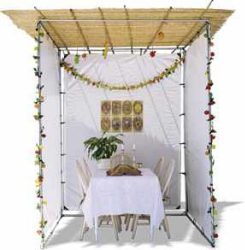 It is most significant for us, not in the words we pray or the stories we tell – but in the things we do. First and foremost we are taught that for the seven days of this festival we should live in a sukkah for 7 days. The essence of a sukkah is that it should be a temporary dwelling, not your usual solid home, and in particular that its roof should be made of branches or other natural material – but not so much that the sun and rain are blocked out.
 There is another ritual on this festival that is known mainly to people who attend synagogue, though here at the Jewish Home, many of our residents practice it. I am thinking of the ritual of taking the lulav and etrog.
I wish you all Chag Sukkot Sameach, a Happy Sukkot.
Rabbi Anthony Elman
Rabbi Anthony Elman serves as Rabbi of the Jewish Home's Grancell Village Campus. His professional background is multifaceted, encompassing the fields of law, social work, and psychotherapy. Rabbi Elman has been with the Home since his ordination and graduation from the Academy for Jewish Religion-California in May 2007
Labels: Chag Sameach, Corn, Elman, Etrog, For the Spirit, Gourds, Lulav, myrtle, palm, Season of Joy, Sukkah, Sukkot, willow, Z'man Simchateinu
Monday, August 29, 2011
Approaching the Days of Awe
At lunch time every weekday, I will be visiting 18 dining rooms and blowing four powerful blasts of the shofar in each one. The residents and staff love these moments, and so do I. But they are intended to be more than mere fun.
The shofar, of course, is the herald of the New Year. It is also a call to prepare ourselves for Rosh Hashanah and Yom Kippur — the “Days of Awe.” So what kinds of preparation are appropriate?
We are all familiar with the “outer” preparations for family gatherings at the New Year. There are the dinners we will share; the clothes we will wear in synagogue in honor of the occasion; the beautification of the synagogue itself, the flowers and the white coverings for the Torah scrolls.
But when we look beneath the surface, and let the sound of the shofar touch our hearts, we hear the call for another kind of preparation — the beautification of our selves, deep down inside. The way we do this is through personal reflection. This is the true call of the shofar, and the grandest task in Elul, the month before Rosh Hashanah.
In preparation for the New Year, I find it helpful to ask ourselves a few important questions, such as:
- Of all the things I have accomplished in the past year, what pleases me most or makes me most proud? In what ways did I live up to my highest standards?
- How have I let myself down by failing to live up to these standards, or being less of a mensch than I could have been?
- Have I apologized to people I’ve wronged? Can I find the courage to do that?
- What can I do that will make my life and the lives of others a little better in the coming year?
- What can I do next year that will make me more proud of who I am?
Our goal should be to come out of Yom Kippur free from sense of guilt or failure, and inspired to improve ourselves in the coming year. That is why the end of Yom Kippur is such a joyful time.
At the New Year, we will share apples and honey with families and friends, and wish each other a happy and sweet new year. We will ask to be written into the Book of Life for a good year ahead.
Our preparation in the coming weeks enables us to come confidently before G-d to make that plea. May the sweetness of the New Year arise from your true striving to become the best person you can be.
I wish you and your family a Happy, Healthy, and, yes, a Sweet New Year.
Rabbi Anthony Elman serves as Rabbi of the Jewish Home's Grancell Village Campus. His professional background is multifaceted, encompassing the fields of law, social work, and psychotherapy. Rabbi Elman has been with the Home since his ordination and graduation from the Academy for Jewish Religion-California in May 2007.Labels: Days of Awe, Elman, Feature Articles, For the Spirit, New Year, Preparation, Rosh Hashanah, Shofar, Yom Kippur
Thursday, July 28, 2011
Letter from the Rabbi – Blessings of Aging
I expected to get laughed at. But instead, almost every resident in the class was able to talk about some of the blessings of being older. Some talked of being wiser. Others spoke of the joy of watching their families – their children, grandchildren and great-grandchildren – and that this time of life was filled with the love they could give to their families, and the love they received from them. With less responsibility now, there was greater time and freedom just for the good things. Another theme emerged, too. There was time and opportunity to reach out and help others here at the Home. Many talked of living in the Jewish Home as a blessing: they received so much, and could also give so much.
None of these residents was being starry-eyed. None pretended that old age was just paradise, without real disadvantages. One woman said: there are good things about being older, but there are more bad things. But even she was happy to tell me about the blessings in her life.
Let me tell you about one of the Torah stories we read this month. The Israelites, on their journey towards the Promised Land, passed through a country whose king was so frightened of them that he called on Balaam, a foreign prophet, to come and curse them. But God made sure that all the words that came out of Balaam’s mouth were not words of curse, but instead words of blessing, telling of the Israelites’ future success.
Just as God turned curse into blessing, we too have the ability – if only we are willing – to turn curse into blessing. I often talk of recognizing God’s blessing in the events of our life – even seemingly negative events. This is not something magical, like kidding ourselves that dark is really light. But we do have greater power over our lives than we often think. Many years ago I was asked, how does one become blessed? I answered that if we feel blessed, then we are blessed. Changing our attitude towards life can actually change the way we experience life. That is the way we turn curse into blessing.
A resident who has recently changed location within the Home has been finding it so painful leaving behind familiar people – both residents and staff – that she can’t enjoy life where she is now. I know this can be painful, but I have also been suggesting to her that each day she try to find one good thing about her new surroundings, one little blessing. She tells me she is still finding it difficult, but I believe she is beginning to experience good, to find blessing in her new life.
Another resident can’t throw off a great weakness, and is wondering whether she is coming close to the end of her life. She says she feels this as failure, but I have been encouraging her to look at what a positive life she has led and how she has all her faculties – and her sense of humor – in her late nineties. I hope she can come to see her life as a blessing, even now, as that life may possibly be moving towards its end – an end that is of course an inevitable part of all our lives.
In the story, Balaam’s lips wanted to speak negative things, just like so many of us want to speak or think of the negative in our lives. Perhaps we can let God help us to change those words on our lips into positive recognition of our blessings. Let’s speak those words of blessing out loud, just as Balaam did. Each morning we could thank God out loud – for another day of life, or for the prospect of sitting out in the sun, or for some other blessing, such as family, or friends, or a favorite nurse, or indeed the blessing of the Home itself.
Rabbi Anthony Elman serves as Rabbi of the Jewish Home's Grancell Village Campus. His professional background is multifaceted, encompassing the fields of law, social work, and psychotherapy. Rabbi Elman has been with the Home since his ordination and graduation from the Academy for Jewish Religion-California in May 2007
Labels: Aging, Around the Home, Blessings, Blog, Conversation with the Rabbi, Elman, Family, For the Spirit, Israelites, Judaism, Letter from the Rabbi, Seniors, Transition
Monday, June 6, 2011
On Shavuot
But one commandment, the final one, always seems to me to be different from the others. It is not about worship, and it is not about what we do to others. It is about what goes on in the secrecy of our thoughts and our longings: we are told not to look over our garden fence and covet our neighbor’s house or wife or anything of his.
I have come to think of this odd commandment as an absolute necessity for a happy and fulfilled life. It is about wanting what is not mine. Many people have a tendency to see other people as having great advantages, whether financially, or in brain power, or in the beauty or seeming happiness of their family. This tendency leads to what can sometimes be the two most pernicious words in the English language – “if only”! If only I had a Mercedes like his! If only my wife/husband were elegant like that.
When we long for what is not ours, we are impoverished. A famous teaching in the Ethics of the Fathers goes like this: Who is a rich person? The person who is happy with his/her lot in life. This does not mean that we should not try to improve our lives. Of course it is good to strive for excellence in our various endeavors. Of course it is proper to work to better our financial situation or to do all we can to improve our health.
But I think there is a difference between trying to improve our lives, and the moping “if only” that is based on comparison to others. The problem may lie not only in jealousy of others, but in longing for what I myself once had. Let me explain: here at the Jewish Home, the residents who successfully build new lives are those that can say: This is my life, I will make the best of it. In contrast, those whose energy goes into longing for what was, when they were independent and ran their own homes, can never quite reach the place of finding life a blessing, thanking G-d for it, and finding new friends and new activities.
That tenth Commandment can be a reminder to us all that this is our life to lead in the fullest way we can – and a reminder of the wonderful wisdom of Torah!
Chag Shavuot Sameach – Happy Shavuot.
Rabbi Anthony Elman serves as Rabbi of the Jewish Home's Grancell Village Campus. His professional background is multifaceted, encompassing the fields of law, social work, and psychotherapy. Rabbi Elman has been with the Home since his ordination and graduation from the Academy for Jewish Religion-California in May 2007
Labels: Covet, Elman, Envy, holiday, Jewish Holiday, Live Life to the Fullest, Richness, Shavuot, Ten Commandments, Torah, Wanting
Monday, April 18, 2011
Letter from the Rabbi – In Praise of Freedom, Part II
When I was discussing Passover in one class recently, I asked what freedom was about. The first answer I got was "the right to express yourself." Indeed, free expression is one of the central principles of a free society, like in the United States.
But freedom of expression is very important on a personal level too. Even when we are surrounded by other people, we can still feel we are on a desert island. If I feel myself totally alone – an individual without real relationships, not truly part of a community – am I free to express myself? Not really, I think. I can truly express who I am only to people I can trust, people who care for me and will listen to me.
Let us remember, this Passover, that our true freedom lies in relationship and in community. Let our own Exodus be from loneliness to relationship, as we reach out to each other, and get to know cherish each other. Through those caring relationships we will all find our dignity and our freedom.
I wish you all a happy – and heart-warming – Passover!
Rabbi Anthony Elman serves as Rabbi of the Jewish Home's Grancell Village Campus. His professional background is multifaceted, encompassing the fields of law, social work, and psychotherapy. Rabbi Elman has been with the Home since his ordination and graduation from the Academy for Jewish Religion-California in May 2007
Labels: Community, Dignity, Elman, Exodus, For the Spirit, Free Society, Freedom, Freedom of Expression, Friends, Friendship, Island, Loneliness, Passover, Pesach, Relationships, Seniors
Letter from the Rabbi – In Praise of Freedom, Part I
Passover is known as the season of our freedom. But why is freedom so important? Why are people across the Middle East and North Africa even at this moment struggling, and sometimes dying, for freedom? Watching the news of those struggles has led me to think more about what it means to be a free person, and part of a free people.
People held down by a dictatorship or foreign power cannot fully thrive. It is not just that they cannot choose what to do; something in the soul of a people is beaten down. Their imagination and inventiveness are squashed — they are a people without true dignity.
Is freedom simply about being able to do as one wants? (Can any of us really do everything we want?) In our Jewish story, leaving Egypt meant we did not have taskmasters telling us how to live every minute of our day. We were free from those restrictions, but that didn't mean we were free to live a worthwhile and dignified life.
That is why Passover — the season of our freedom — and Shavuot — the season of the giving of our Torah — are so closely connected. Torah gives us laws and ethical principles, so that we know that real freedom lies in how we interact in our community and our larger society. First and foremost, the Jewish people are obliged by Torah to love our neighbor as ourselves; we must not oppress the widow and the orphan; we are repeatedly told to be respectful of the stranger who lives in our society, remember what it was like when we were strangers in Egypt.
Torah reminds me that in a free society, I have a duty of care and consideration for my fellow men and women. The free society that Torah gives us is one in which we are bound together in relationship.
Ideally we do not celebrate Passover in solitude. We celebrate it in groups, in families, in communities. At the Seder, we read from the Haggada "let all who are needy come and celebrate Passover." It is together that we are able to taste the sweetness of this "season of freedom".
Rabbi Anthony Elman serves as Rabbi of the Jewish Home's Grancell Village Campus. His professional background is multifaceted, encompassing the fields of law, social work, and psychotherapy. Rabbi Elman has been with the Home since his ordination and graduation from the Academy for Jewish Religion-California in May 2007
Labels: Civil Rights, Community, Dignity, Egypt, Elman, For the Spirit, Freedom, holiday, Israelites, Judaism, Letter from the Rabbi, Moses, Passover, Pesach, Torah
Wednesday, May 5, 2010
A Giving Time of Life
The horrific earthquakes in Haiti and Chile and the suffering they inflicted have led to a remarkable outpouring of assistance from around the world. The scale of this humanitarian response has led many of us to reflect on the nature of giving.
Material help, like money or food for disaster victims or for the homeless in our own community, is just one of the ways we can, and do, give of ourselves. Some — in war and peace — give their life for others, for their country, or for an ideal.
But giving can also become a way of life. Each of us can choose to share our love or energy, time or advice at every opportunity. We can take a moment to listen or share a thought or a smile that makes someone feel understood, recognized, not alone.
A Culture of Giving
Jewish tradition has quite a lot to say about our personal responsibility to give. The Torah teaches us to protect the "widow and the orphan," which extends to all of the vulnerable in our society. And Judaism puts great emphasis on the concept of "tzedakah." This is a complicated word that draws much of its beauty and authority from its dual focus on doing what is right here and now, and acting in the pursuit of justice.
Thus, by acknowledging his or her cultural identity, a Jew is required to give, especially to relieve poverty and suffering. Tzedakah is not 'merely' an ideal. It is not something we choose to do when we happen to be feeling generous, but an obligation of our tradition and culture.
Giving of this type was exemplified by those many American Jews who worked and risked their lives in support of the Civil Rights Movement of the 1960s. One woman involved in that struggle recalled that her actions were motivated by the principle from the Torah not to stand idly by when others are facing a difficult plight.
Giving as the Basis of the Community
In order to create a true community, must we each contribute in some way? Almost everyone I ask responds 'yes' to this question. But more than just enjoying the benefits of belonging to a community, people seem naturally motivated and energized to contribute, and are often creative about finding opportunities to do so.
For seniors who no are no longer independent, these opportunities are not as obvious as they once were. But by contributing our love and energy, time or advice, we can create the sense of community almost anywhere. A simple gesture of warmth, friendship, or conversation with others at a nursing station or attending an activity or a class — and actively participating at those events — is an act of giving that helps bring the community alive.
Meaning from Each and Every Day
I hear from many seniors who are experiencing a lack of meaning in their lives. Some feel that their time of giving in life — whether this was discovered through raising their family or having a successful career — is over, and with it went much of the meaning of their lives.
To those who wish to find meaning by giving to others, I suggest that the simple acts of kindness and generosity, or participation in community wherever and whenever the opportunity arises, are real and valuable moments of giving.
Indeed, every opportunity we take to contribute to the life and well-being of the community is a win-win. Others gain from what we give, and we ourselves gain immeasurably from the act of giving.
Rabbi Anthony Elman serves as Rabbi of the Jewish Home's Grancell Village Campus. His professional background is multifaceted, encompassing the fields of law, social work, and psychotherapy. Rabbi Elman has been with the Home since his ordination and graduation from the Academy for Jewish Religion-California in May 2007
Labels: Community, Elman, Feature Articles, For the Spirit, Giving, Judaism, Philanthropy, Tzedakah